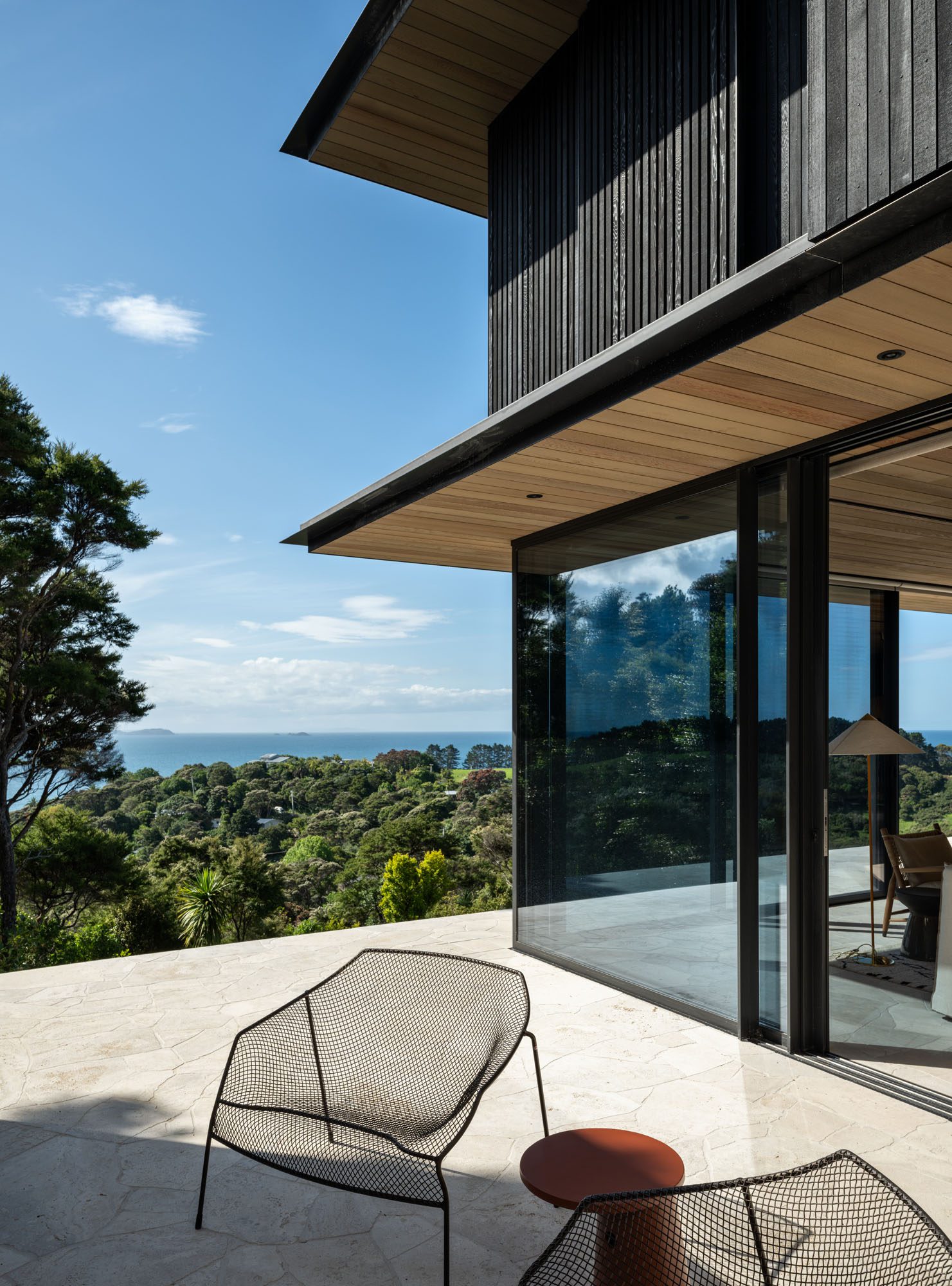
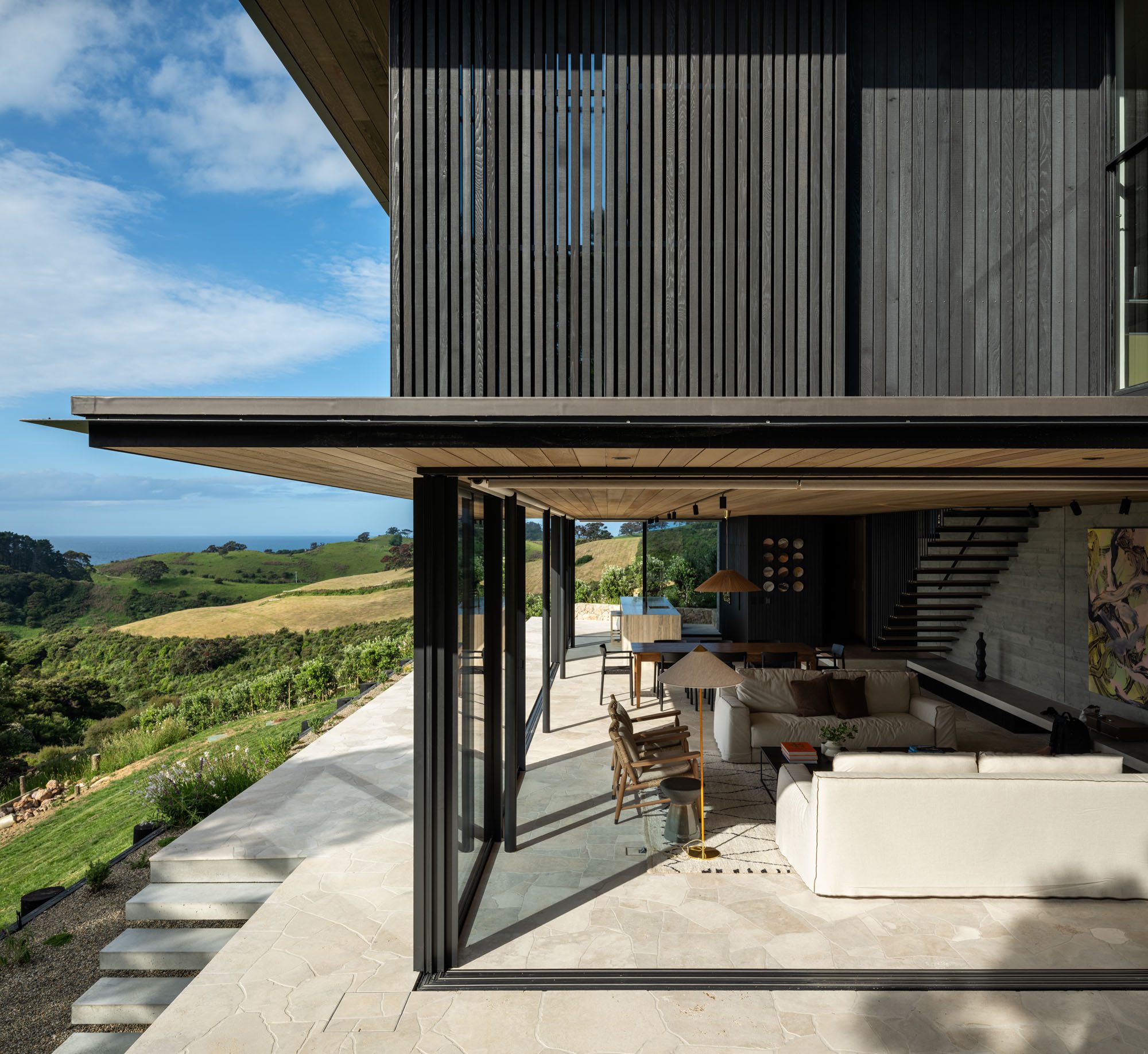
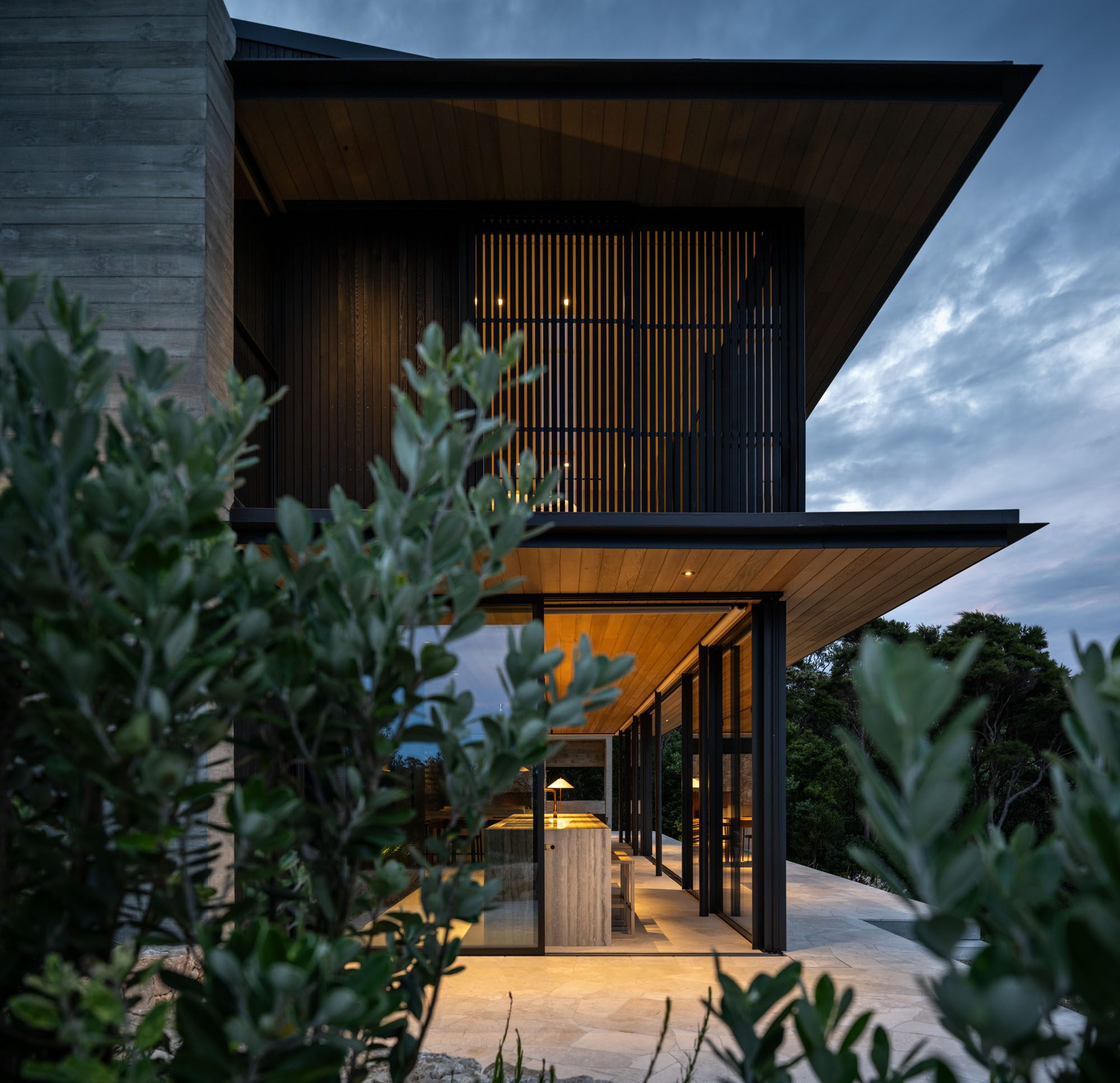
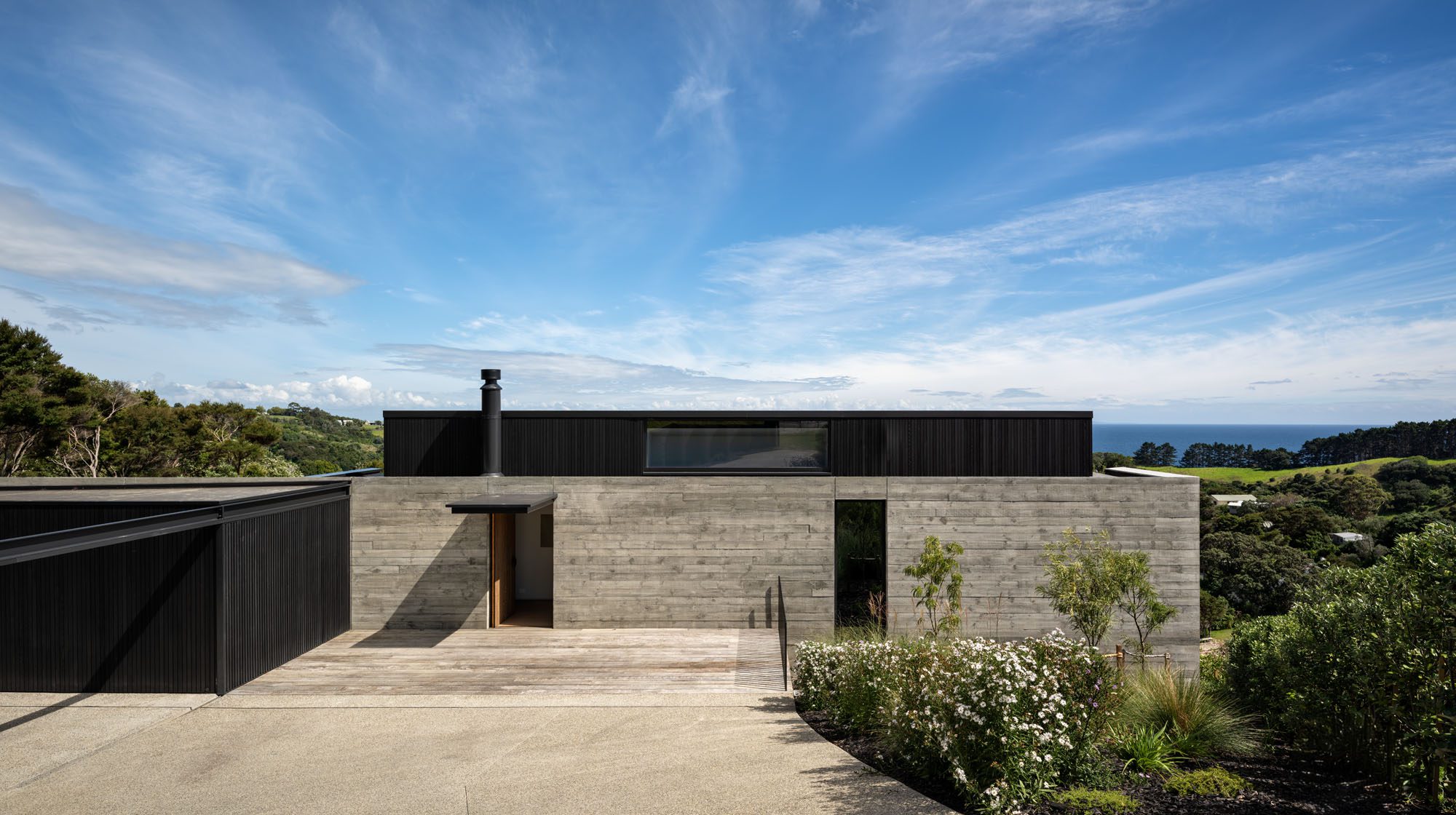
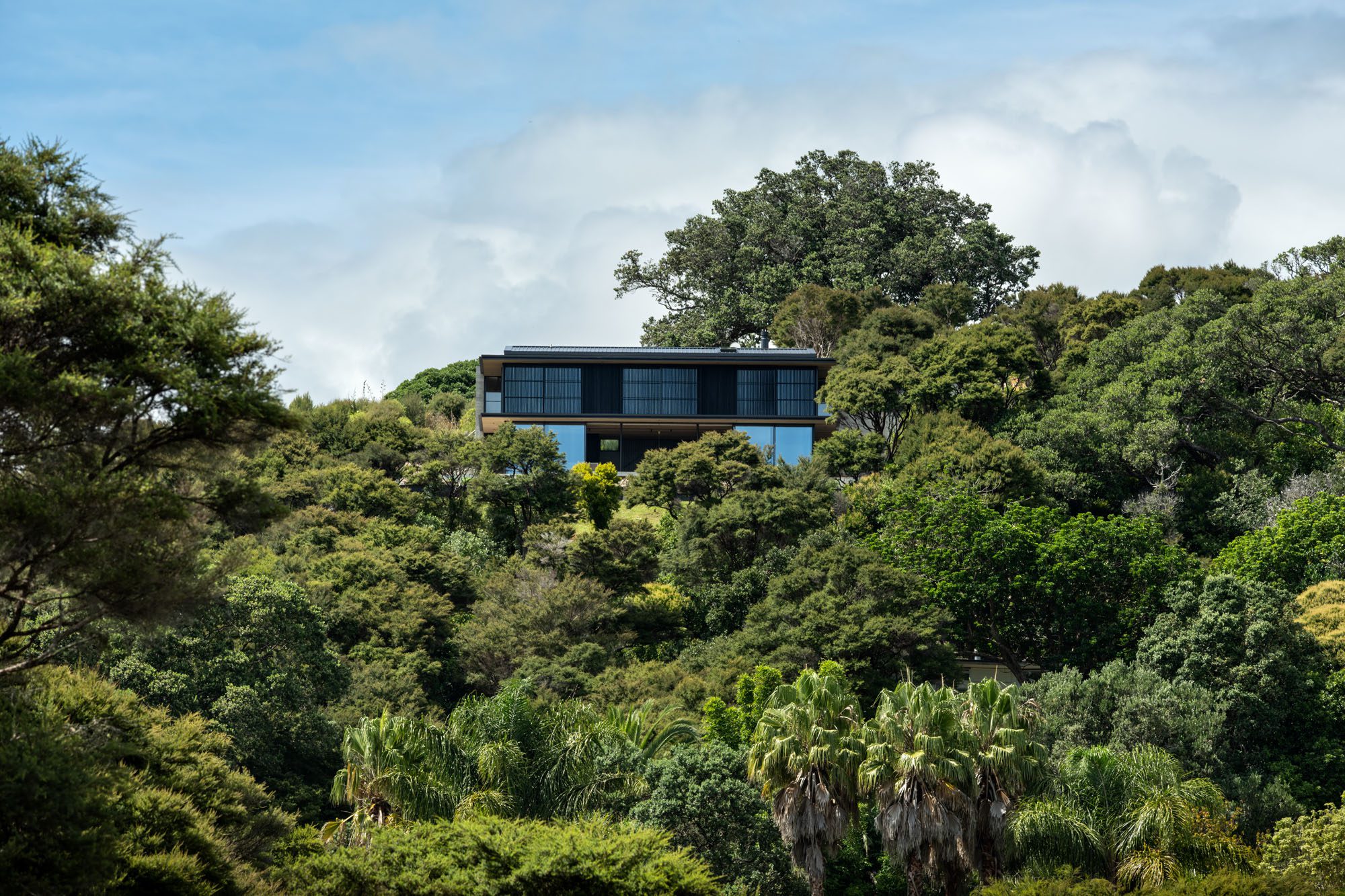


This year’s coastal category winner is a home for, and by, architect Julian Guthrie, whose passion for materiality and exactitude are expressed here with gusto. The result is a sophisticated, elegant, and entirely relaxing gem that shines above Waiheke Island.
On a tricky piece of land, situating the house is half the battle.
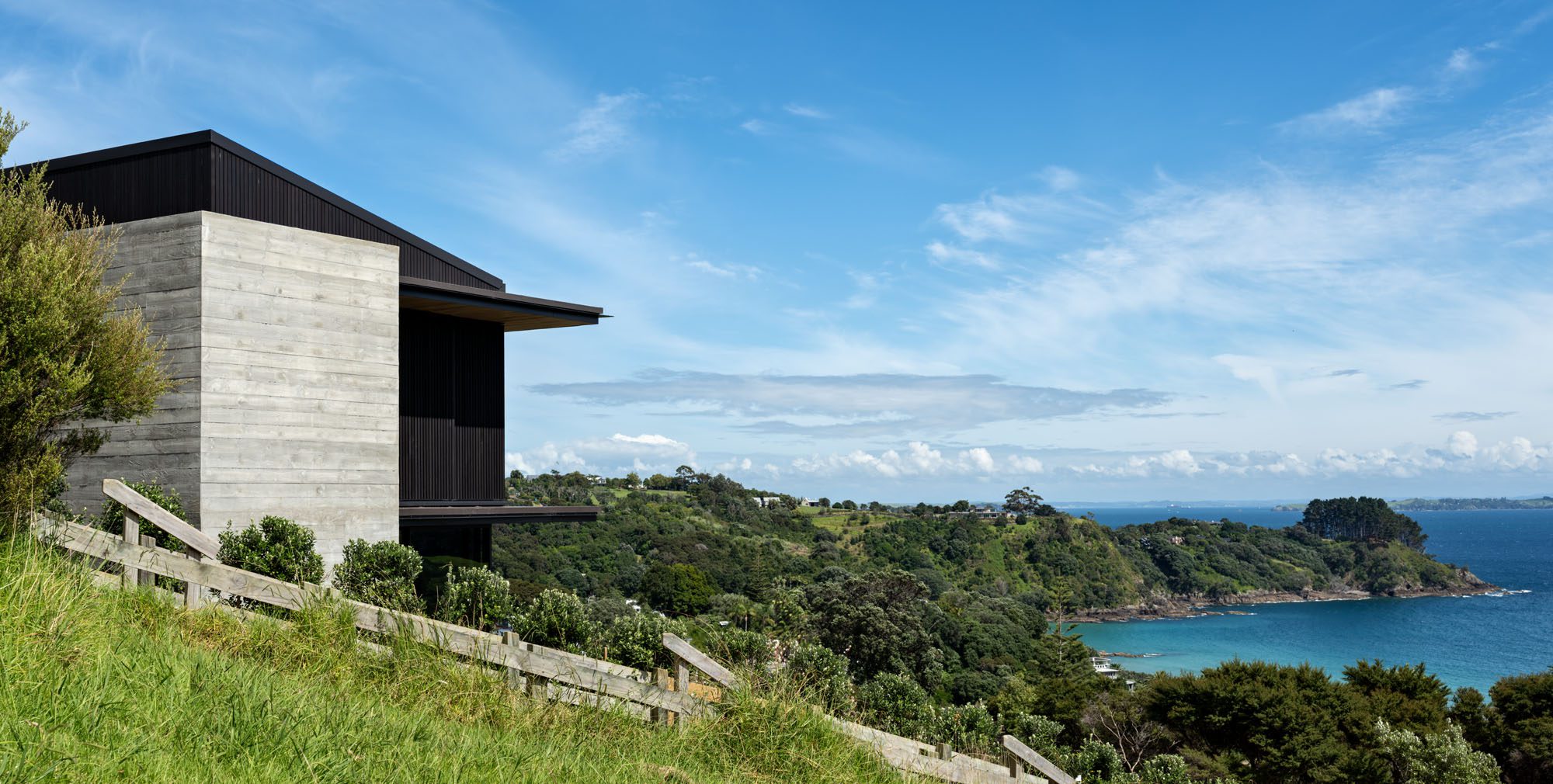
Imagine a quasi-rectangular and tapering site on a rolling hill. At the top southern end of this is the narrowest and least private spot. The public road is there — although, with it being a gated community, the traffic is minimal. There is, however, a public walkway down the entirety of the eastern boundary, which, again, is not exactly booming but had to be taken into consideration during early stages of design.
For a layman, the logical move might have been to tuck the house halfway down the hill against the wider, western side, run a driveway along the east, and create a fortress of hedging. However, that approach would require significant earthworks to flatten the steep slope, retaining walls, redirected water flows, and complex foundations. Add the need to understand long-term sun trajectories and how surrounding young native vegetation might obscure sea views over the next two decades, and the mental reasoning quickly suggests leaving it to professionals.
Architect Julian Guthrie purchased this land with the view of creating a beach house for his own family. His first move was to place the building at the south-east corner, closest to the road and with the tightest setbacks.
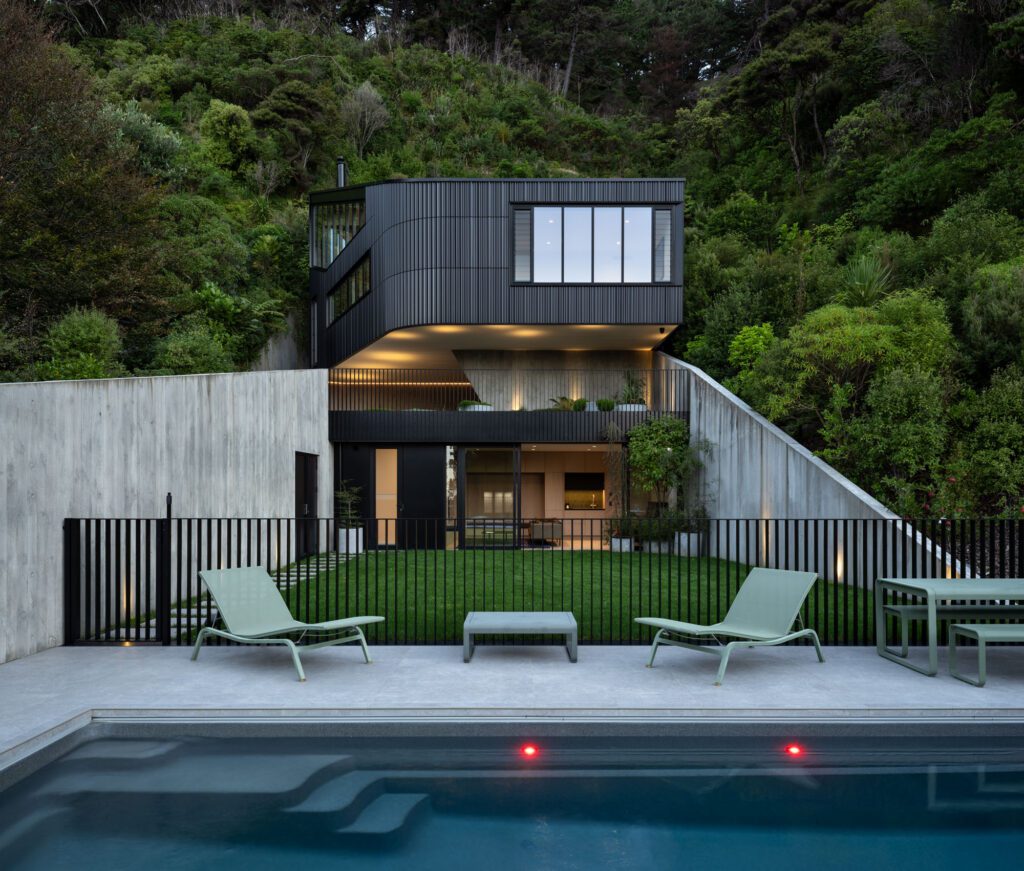
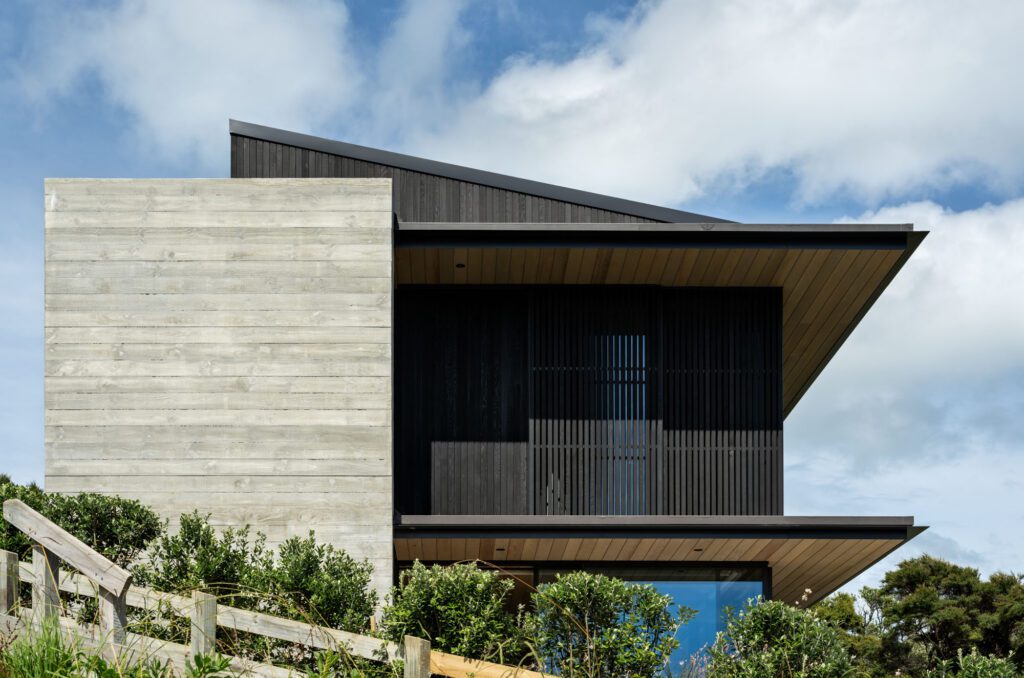
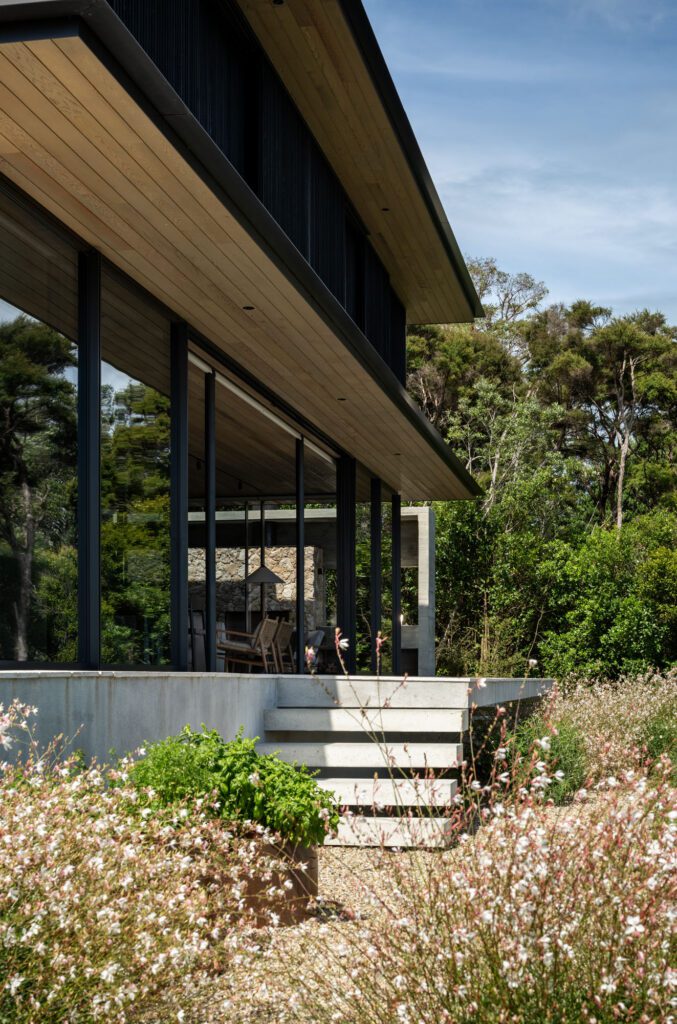
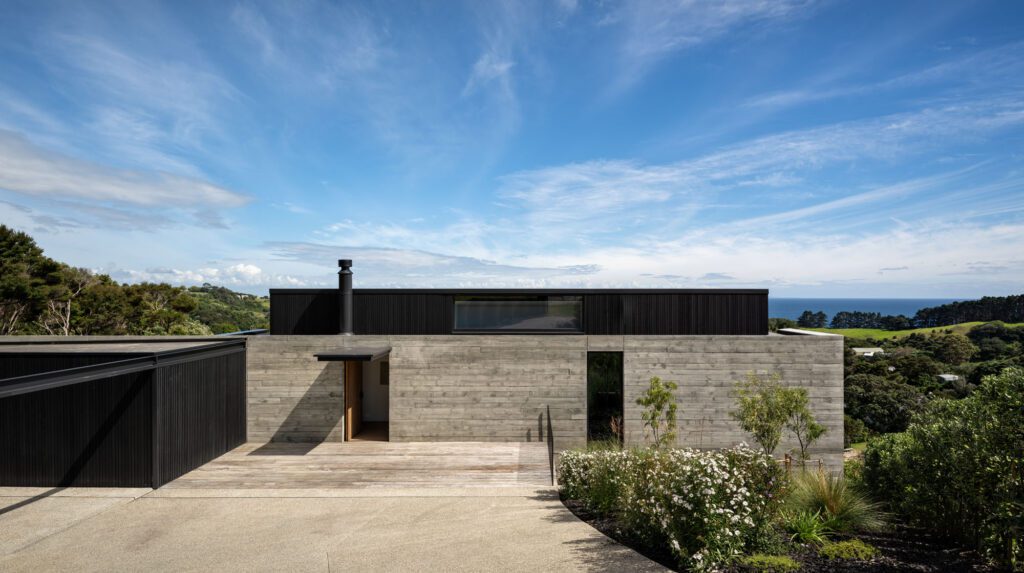
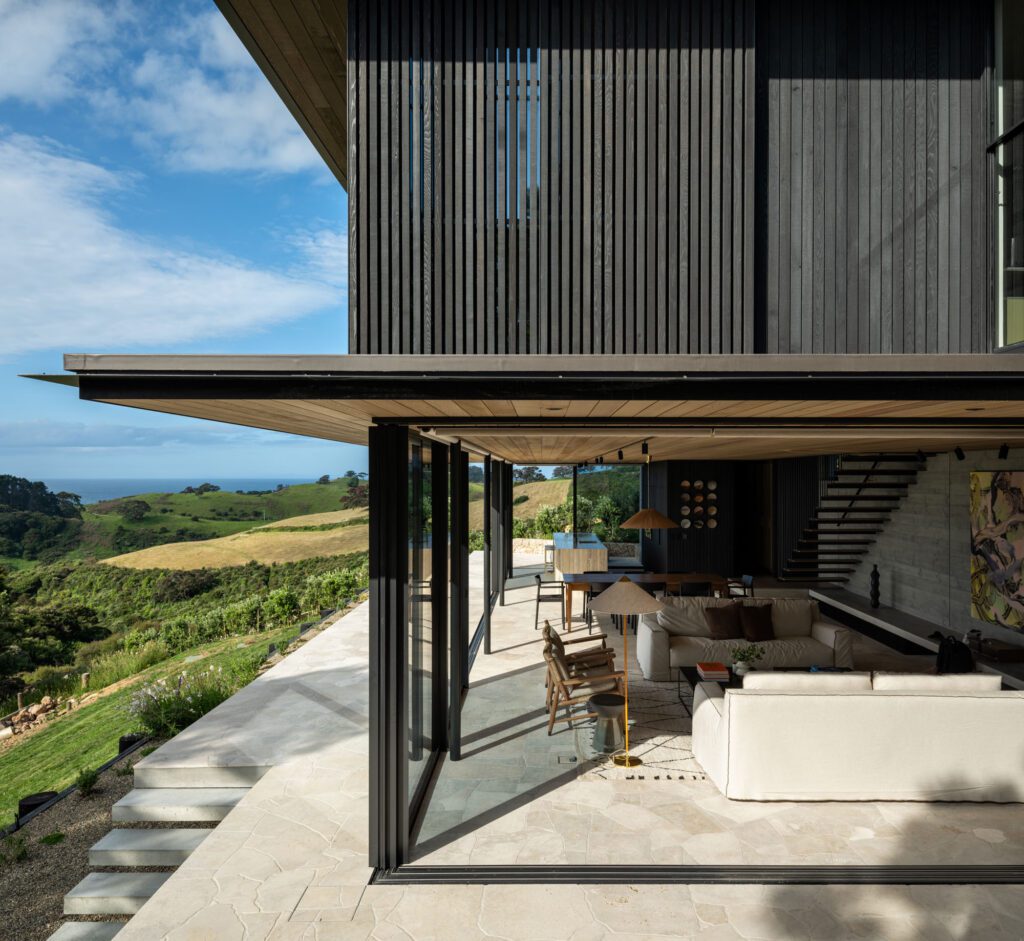
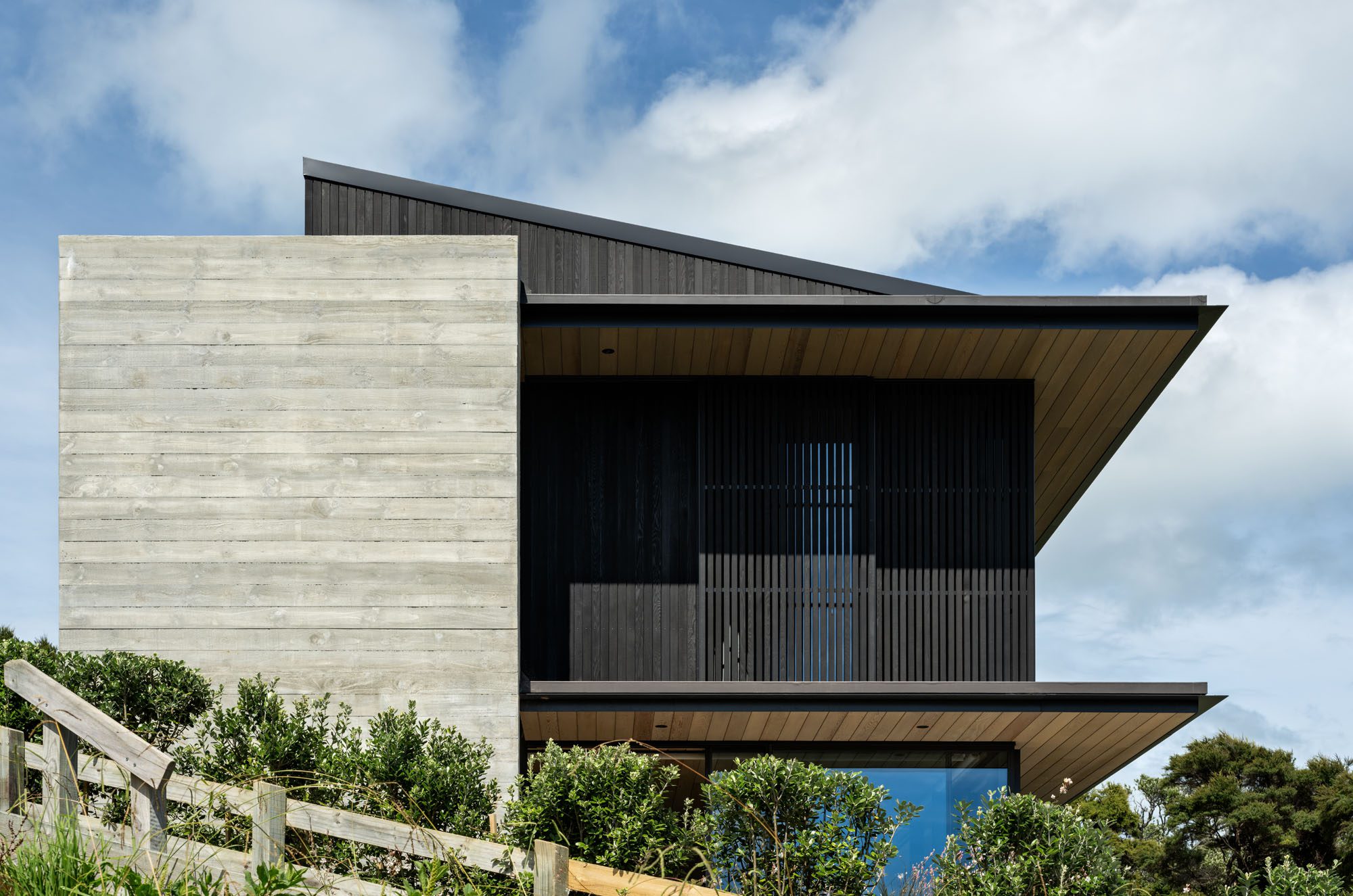
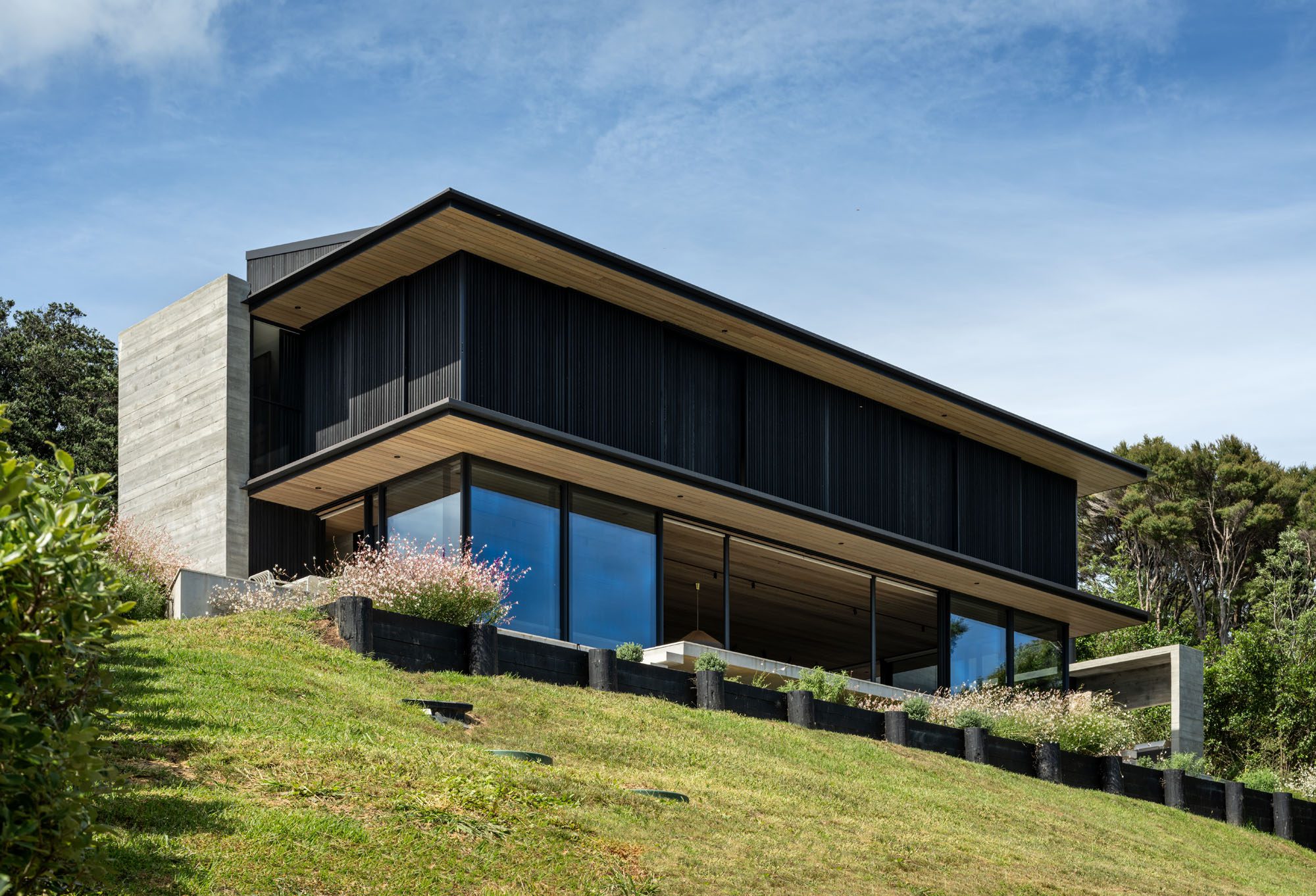
Part of the reasoning was vantage: it is the highest point on the site. It also allowed the driveway to remain short. Julian set the house back 20 metres from the road, “partly so the people at the top of the hill could keep [their view of] the sea.” The building therefore sits slightly sunken from the crest — and here the project’s key move emerges. The slope allowed Julian to construct a substantial in situ concrete wall that functions simultaneously as bracing and façade, with a foundation slab lightly dug in and stepping above the hill’s gradient. The wall digs just enough into the slope to anchor the two-storey house to it.
The plan follows a clear topographic logic: the hillside becomes a structural participant, with the concrete wall acting as retaining element, thermal mass, and load-bearing spine. Everything else hangs from this anchoring datum.
“There are some concrete piers under the front deck here that kind of go back into the hill and tie the whole wall into [it], and then the house, structurally, is just hanging off that. It has no other bracing.”
This elegant solution means the foundations tread lightly on the land and has allowed the sea-facing end of the house “to be quite delicate.”
In true Julian fashion, the concrete is not only structural but immaculate: richly textured and perfectly finished.
“I do have a bit of a concrete [obsession],” the architect jokes — a claim supported by earlier projects such as his Pacific and Pauanui beach houses.
Rather than leading directly to the front door, the driveway arrives at a generous threshold deck built from recycled Australian hardwood so that it feels “more like a bridge or a wharf”, says Julian. The precisely cantilevered awning above the timber entry door, the steel balustrade, and the garage doors: everything here is executed with millimetric precision and robust elegance.
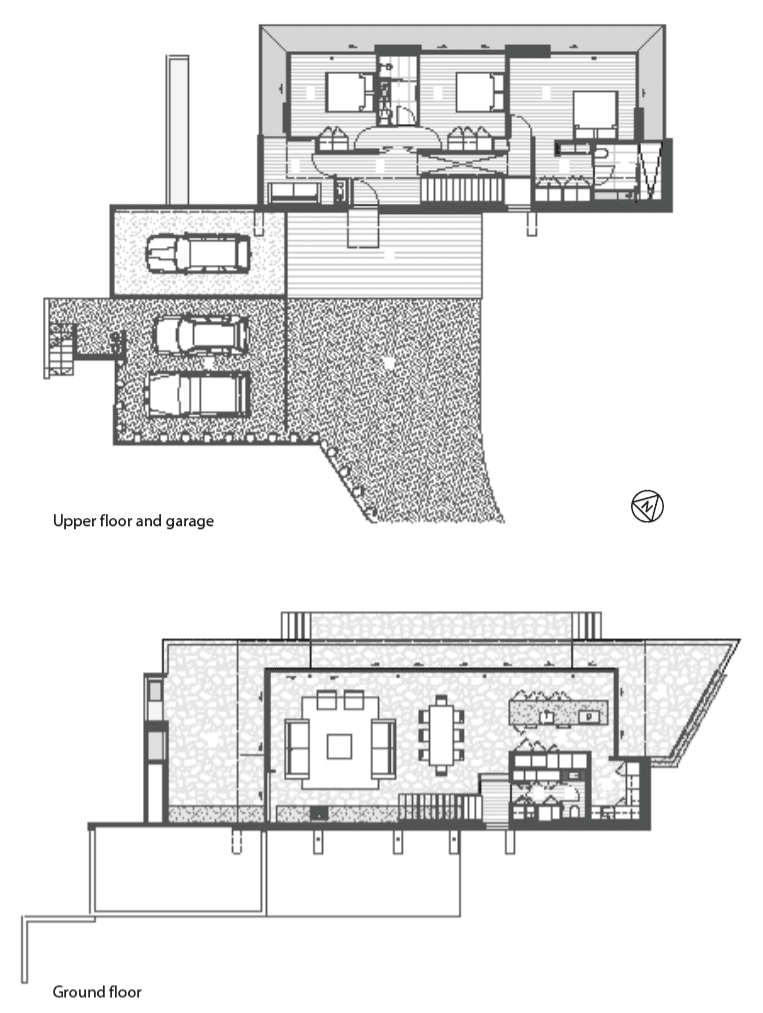
The interior is best understood not as a sequence of rooms but as a sectional idea: a polarity between the compressed privacy of the sleeping quarters above and the expansive release of the living pavilion below.
Entry occurs at the compact upper level, where lowered ceilings create a cave-like sense of shelter. Two nearly identical bedrooms share a bathroom, while the main bedroom includes a walk-in wardrobe and ensuite.
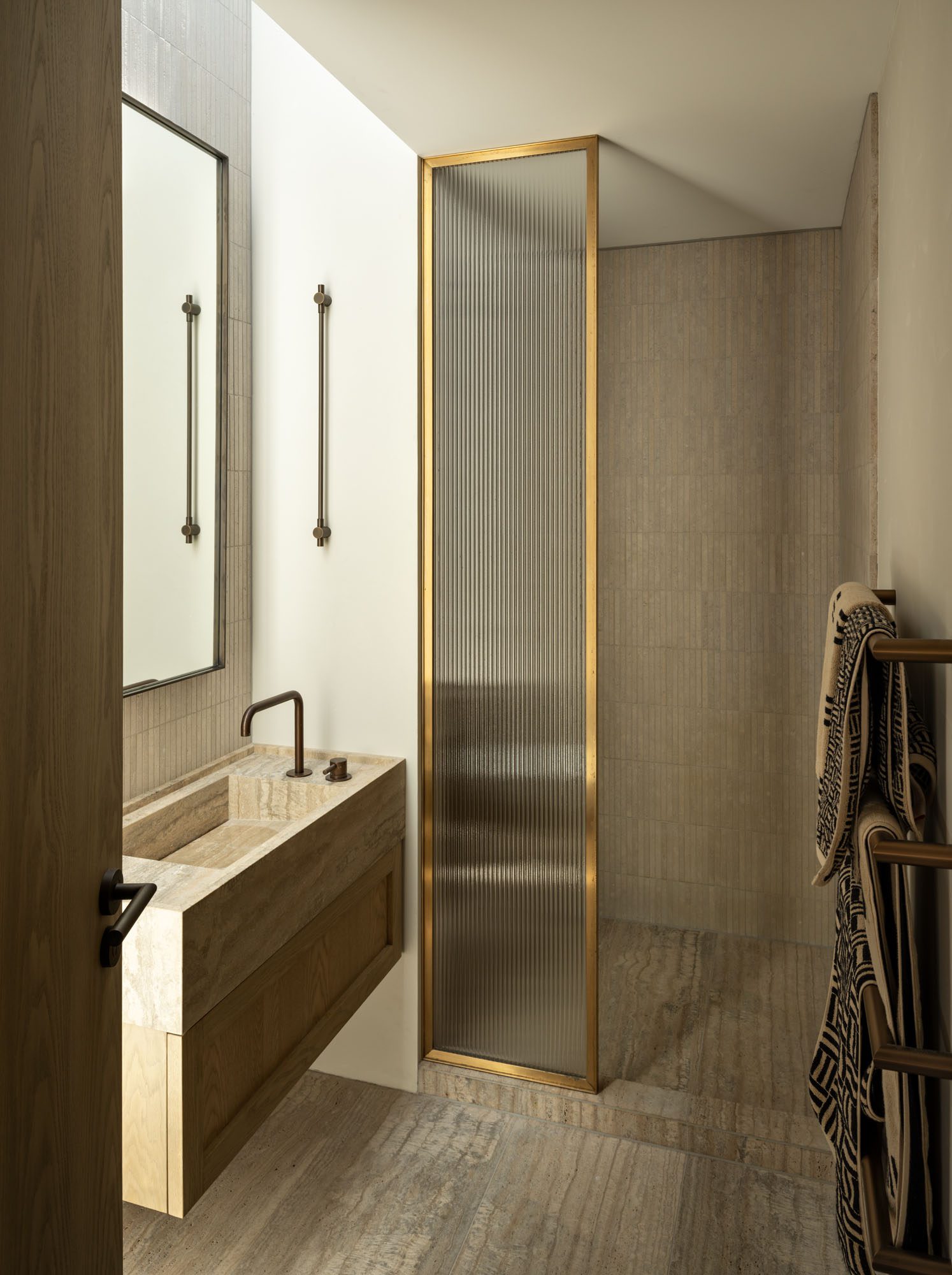
“Probably my favourite space,” says Julian of the ocean-view shower, “with all the nice big tiles from Designsource and the privacy screen to the outdoors.”
Bathroom detailing is exquisite: organic brass accents, fluted glass, and generous overhead natural light.
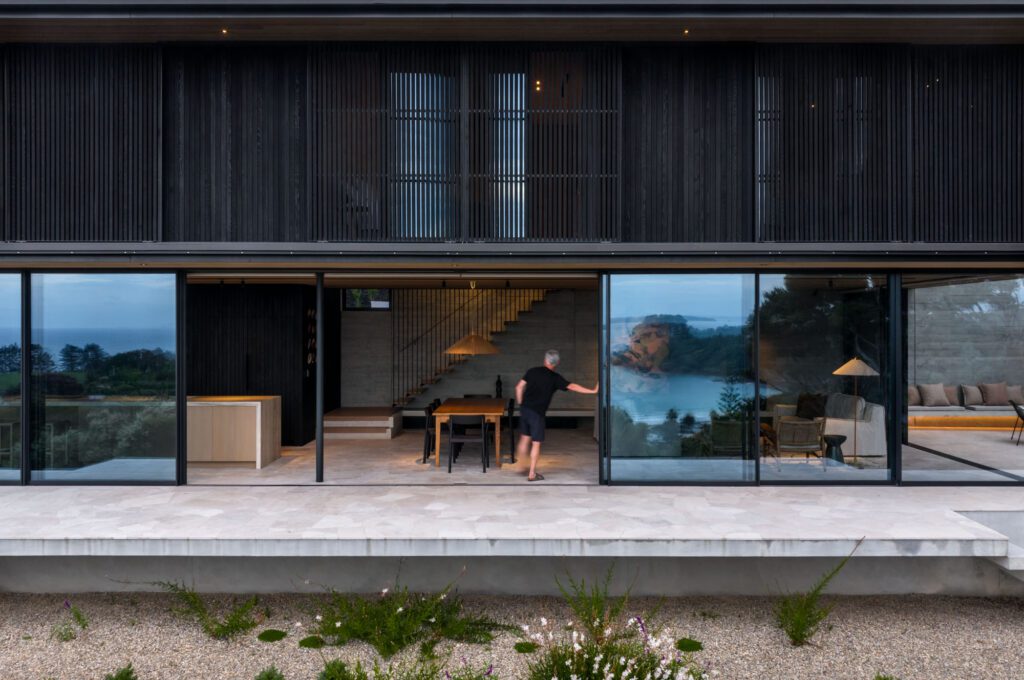
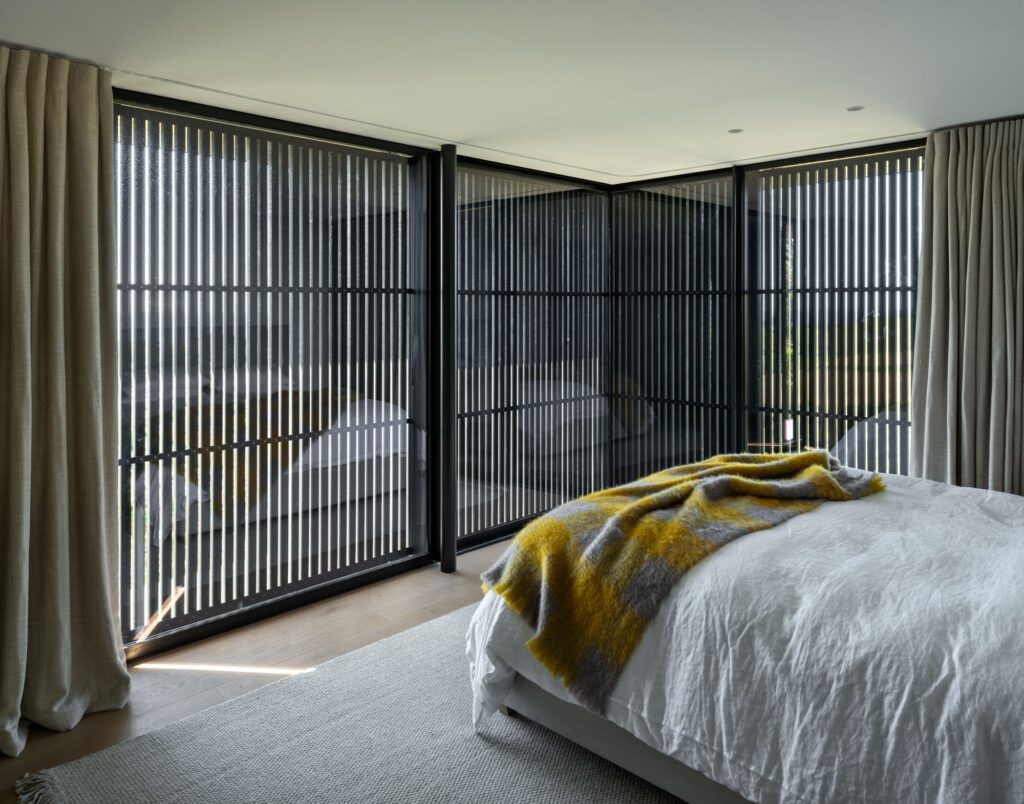
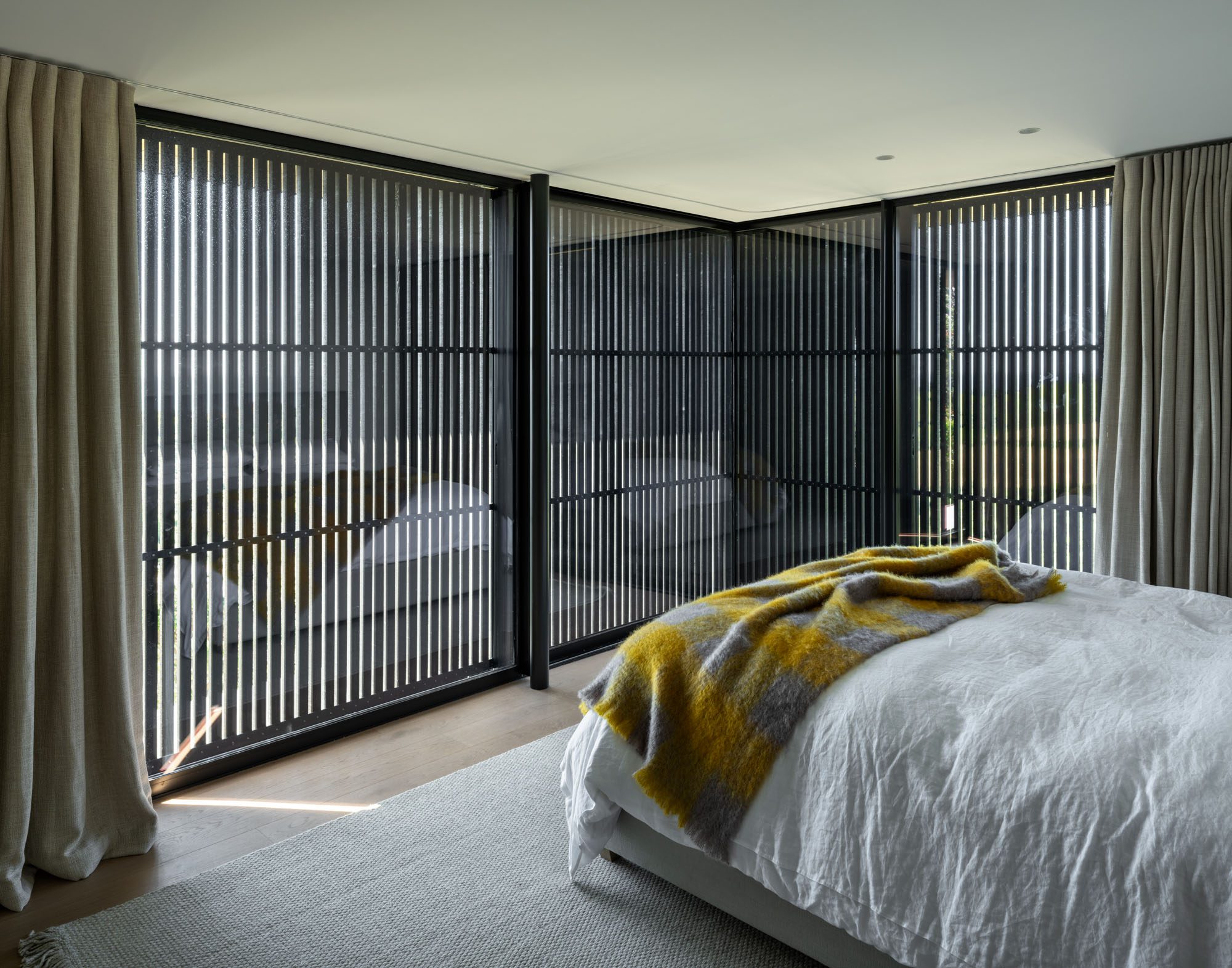
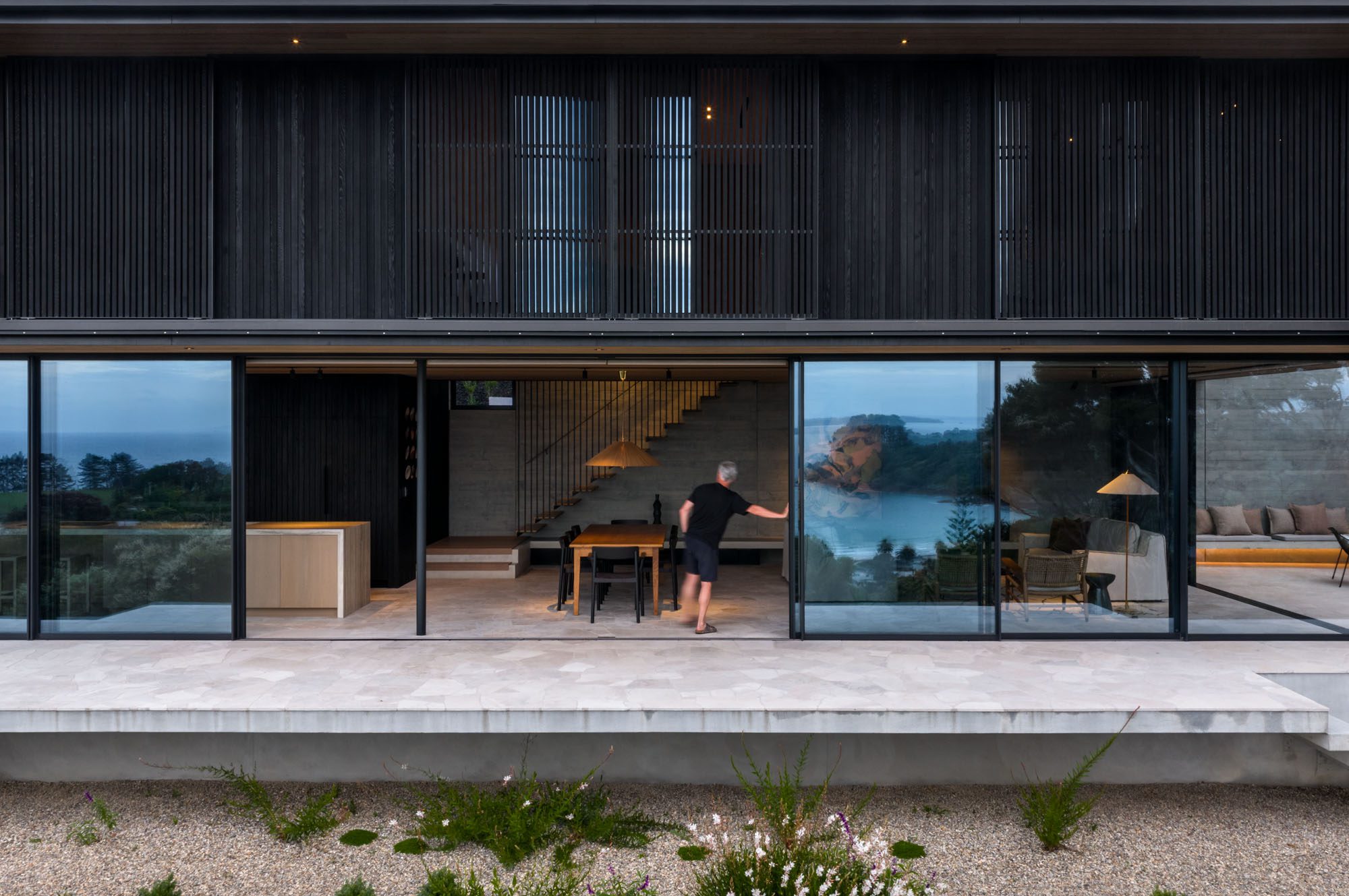
Home of the Year judges described the rooms as resembling a series of luxury hotel experiences: the palette calm and lush, quietly enclosed. Light and breeze are controlled through custom cedar batten and aluminium sliding screens that echo the garage doors. When opened, they form a precise grid across the façade, functioning both as regulator and playful device of transparency.
Internally, this means the quality of light is never static; it shifts from dappled and striated to fully bleached as the panels are drawn aside, the room itself becoming a kind of sundial.
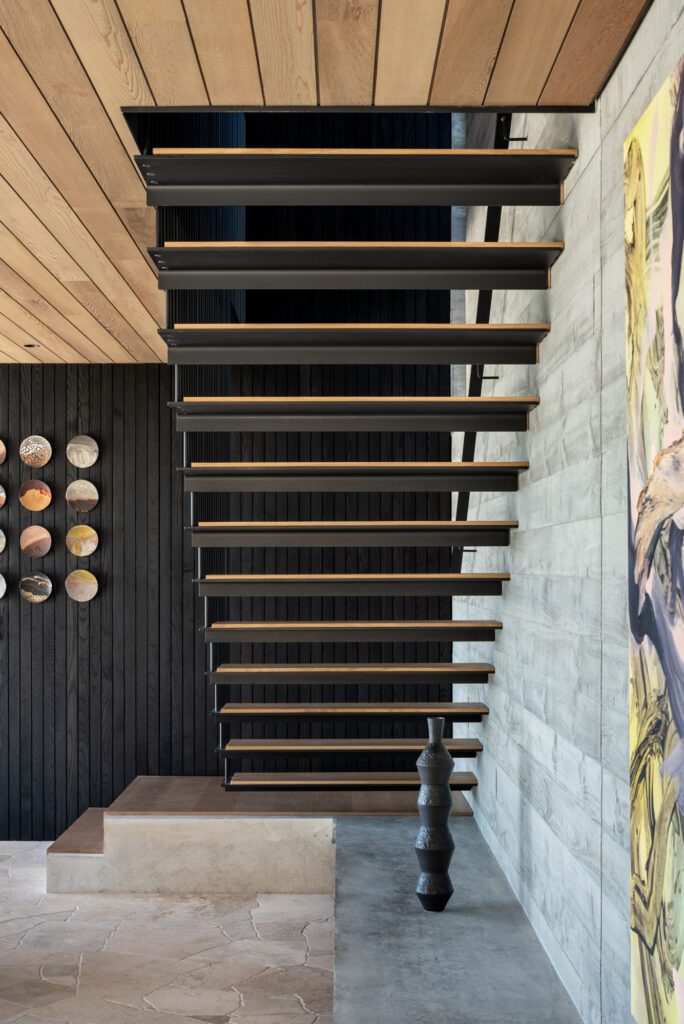
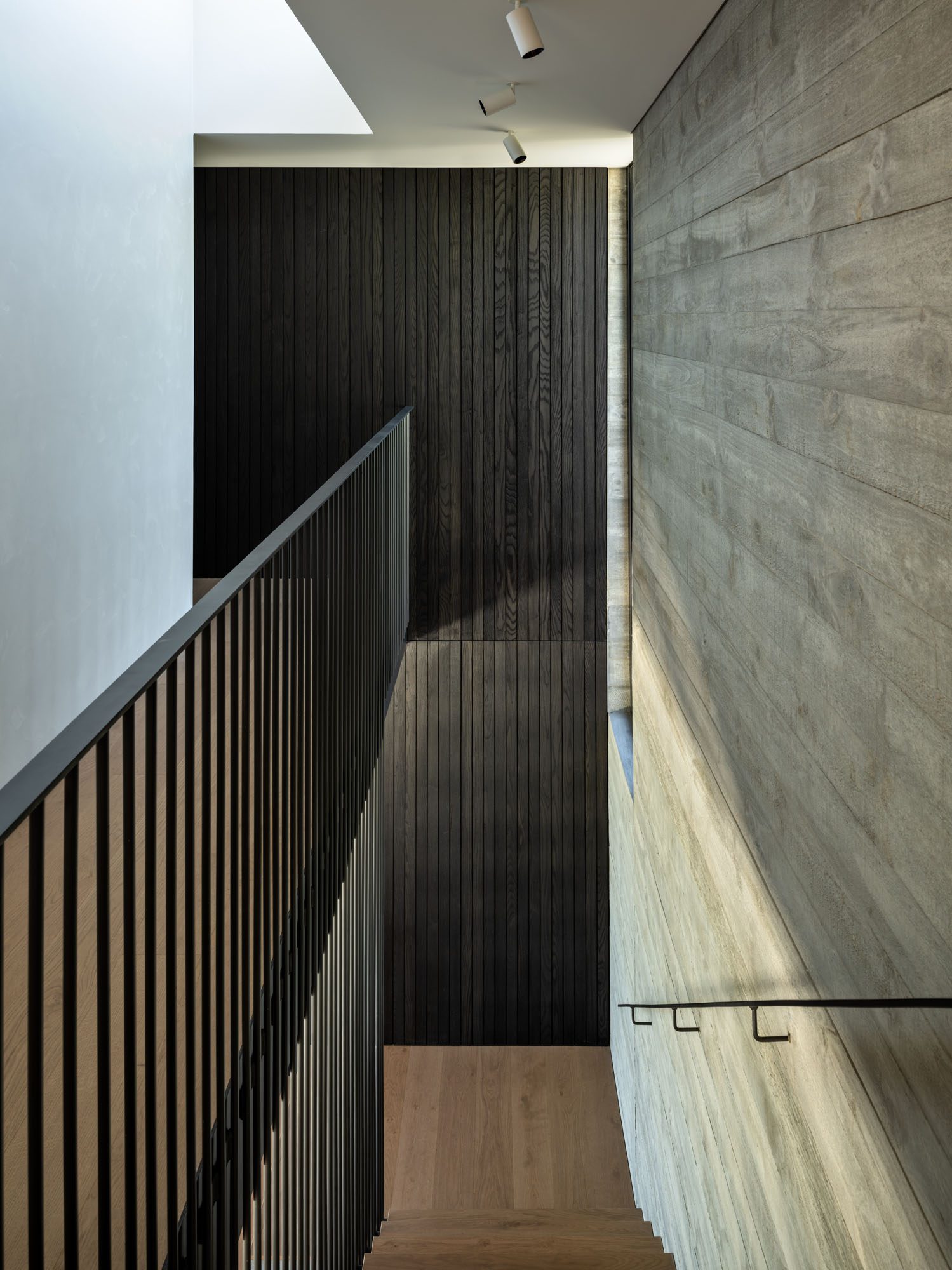
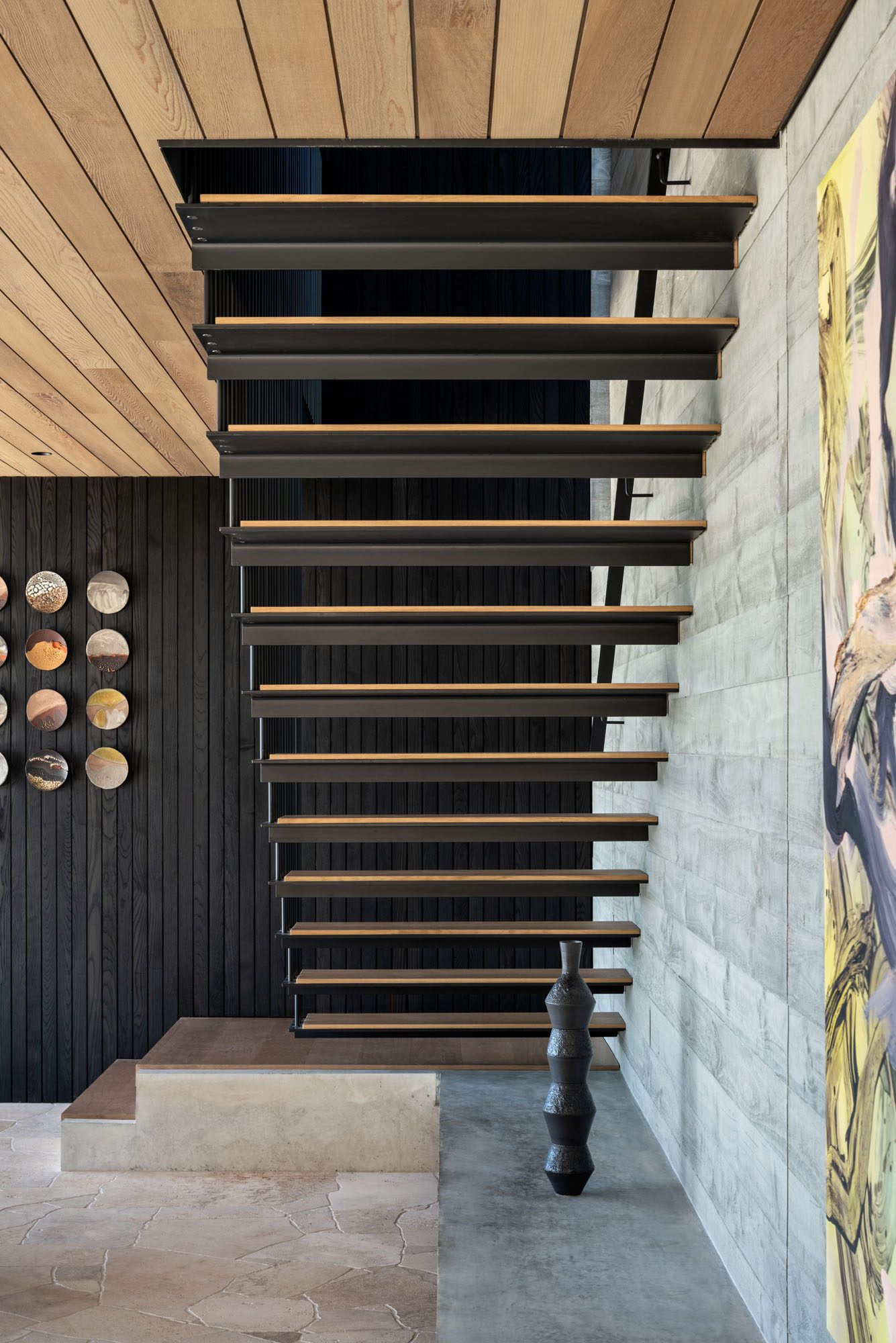
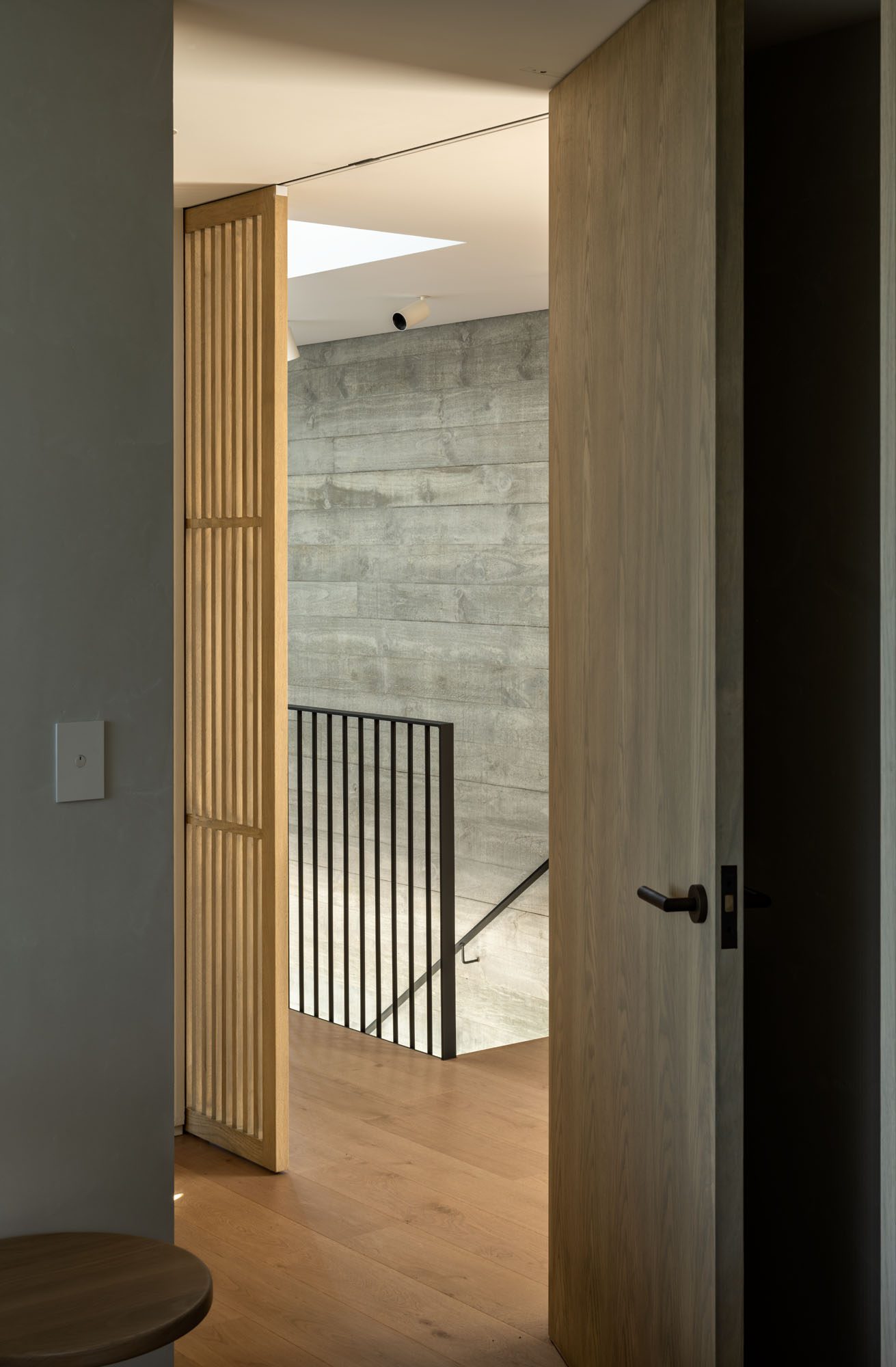
The sectional pivot is a suspended stair threaded with vertical steel rods, gradually revealing what Julian calls the “living terrace house with a variety of spaces.” The space feels almost suspended, reinforcing the sense that the pavilion floats above the ground. In contrast with the solidity of the entry sequence above, the effect is striking.
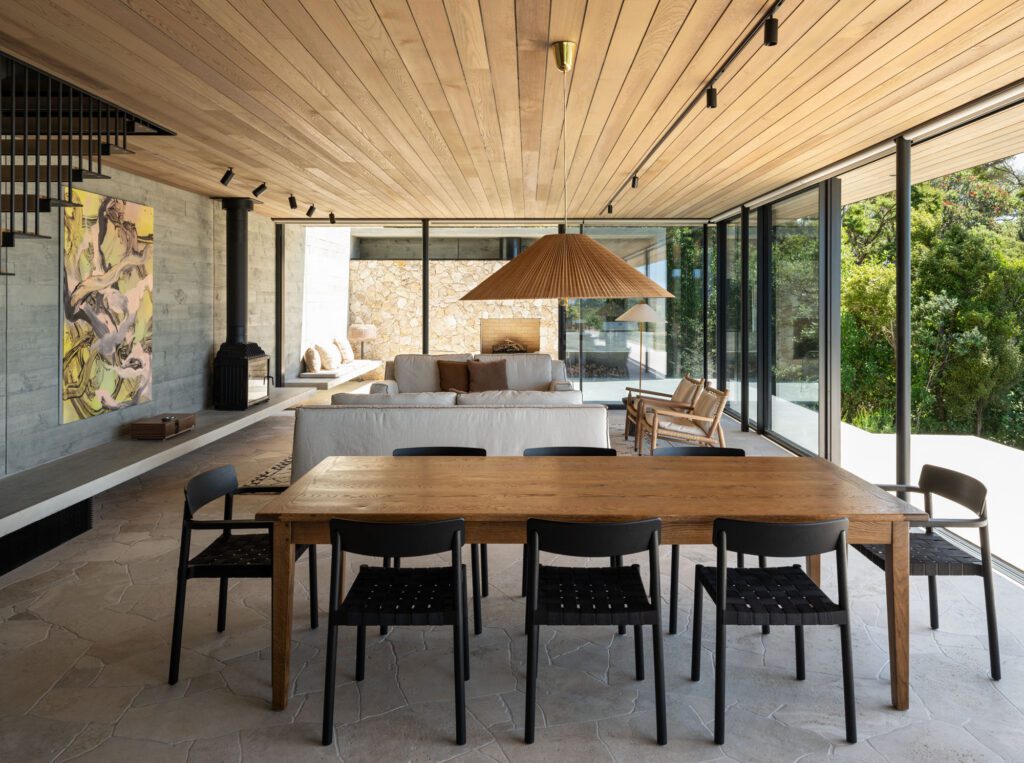
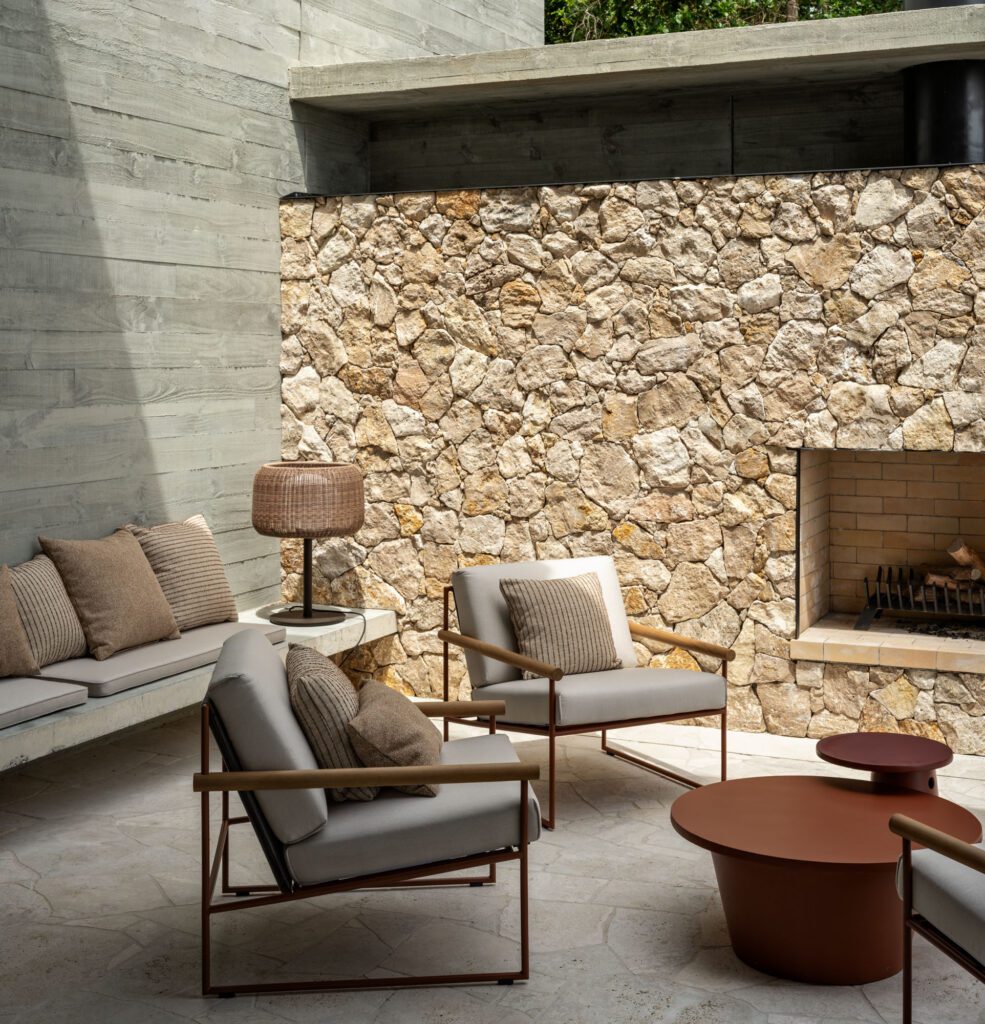
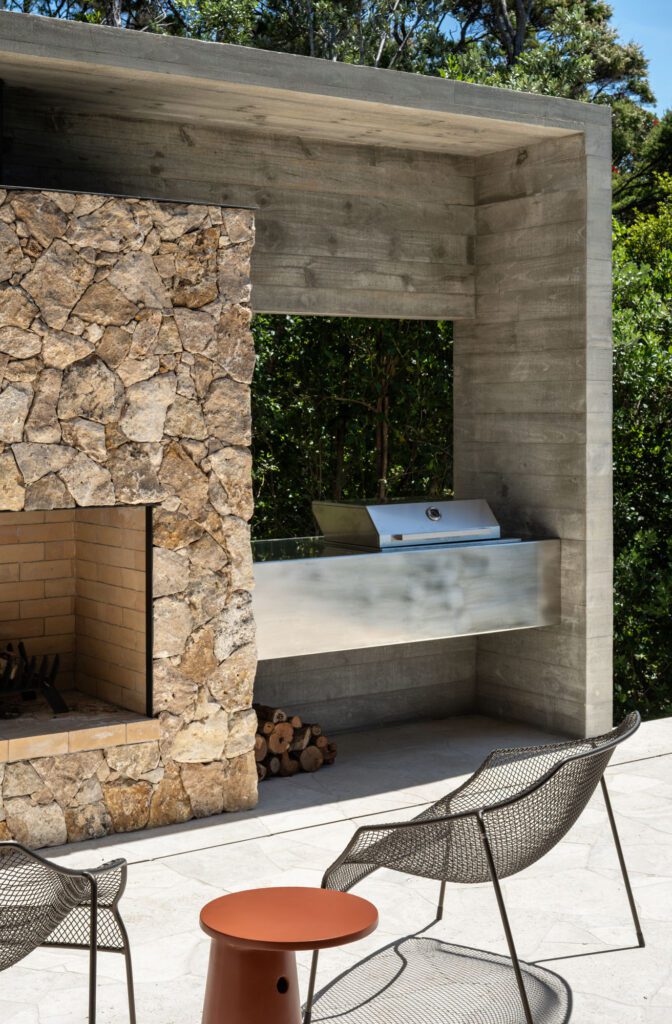
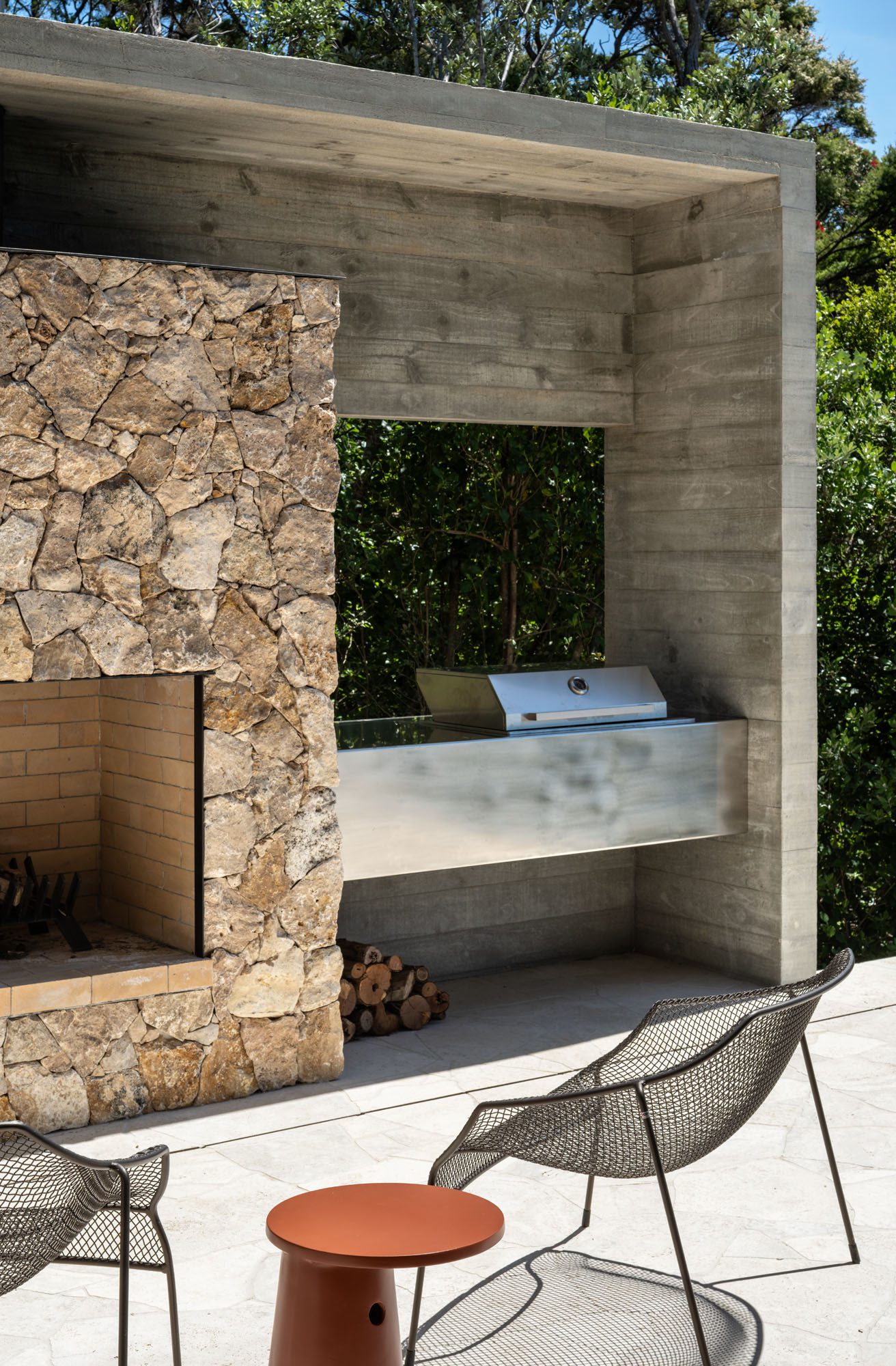
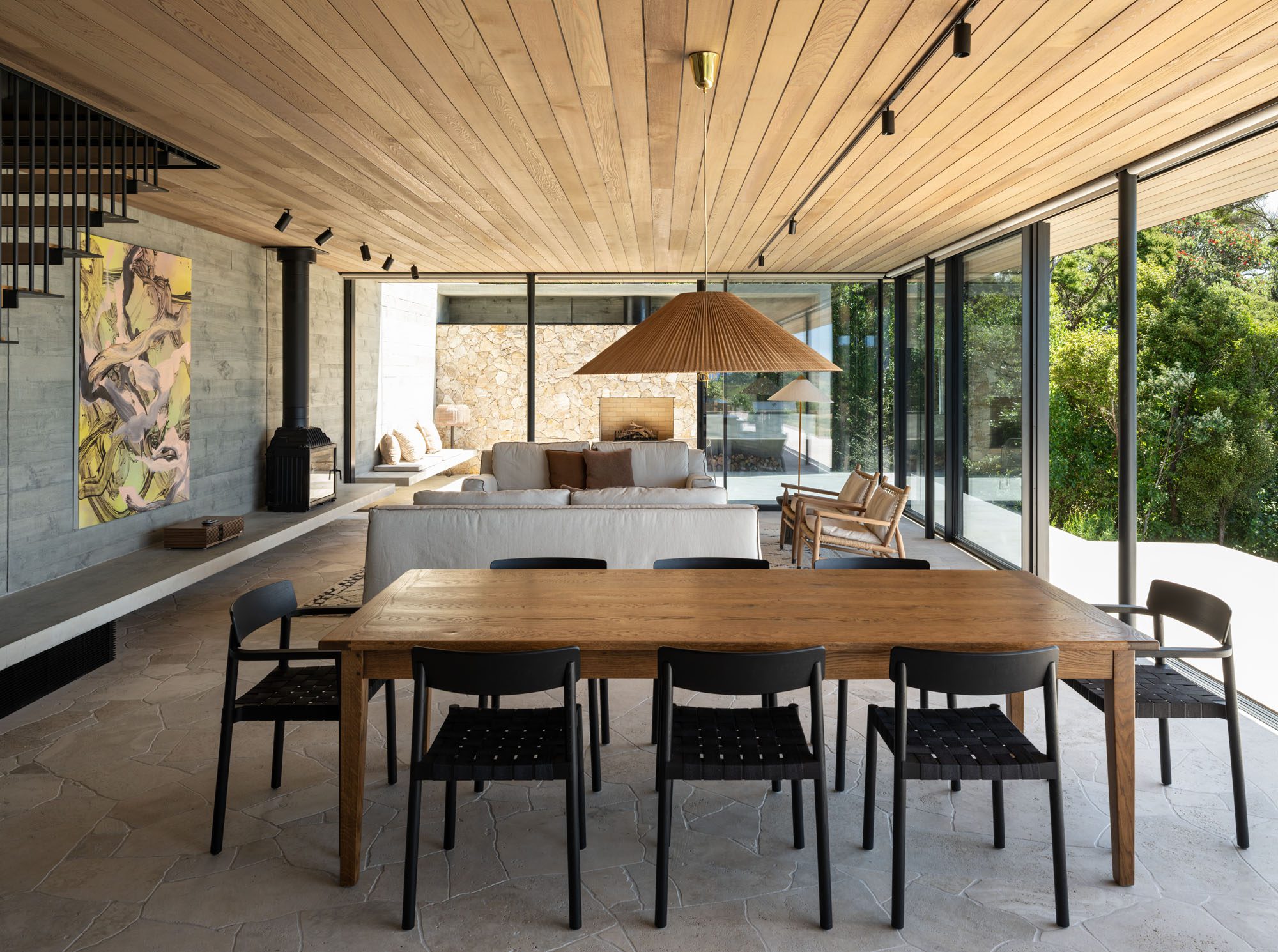
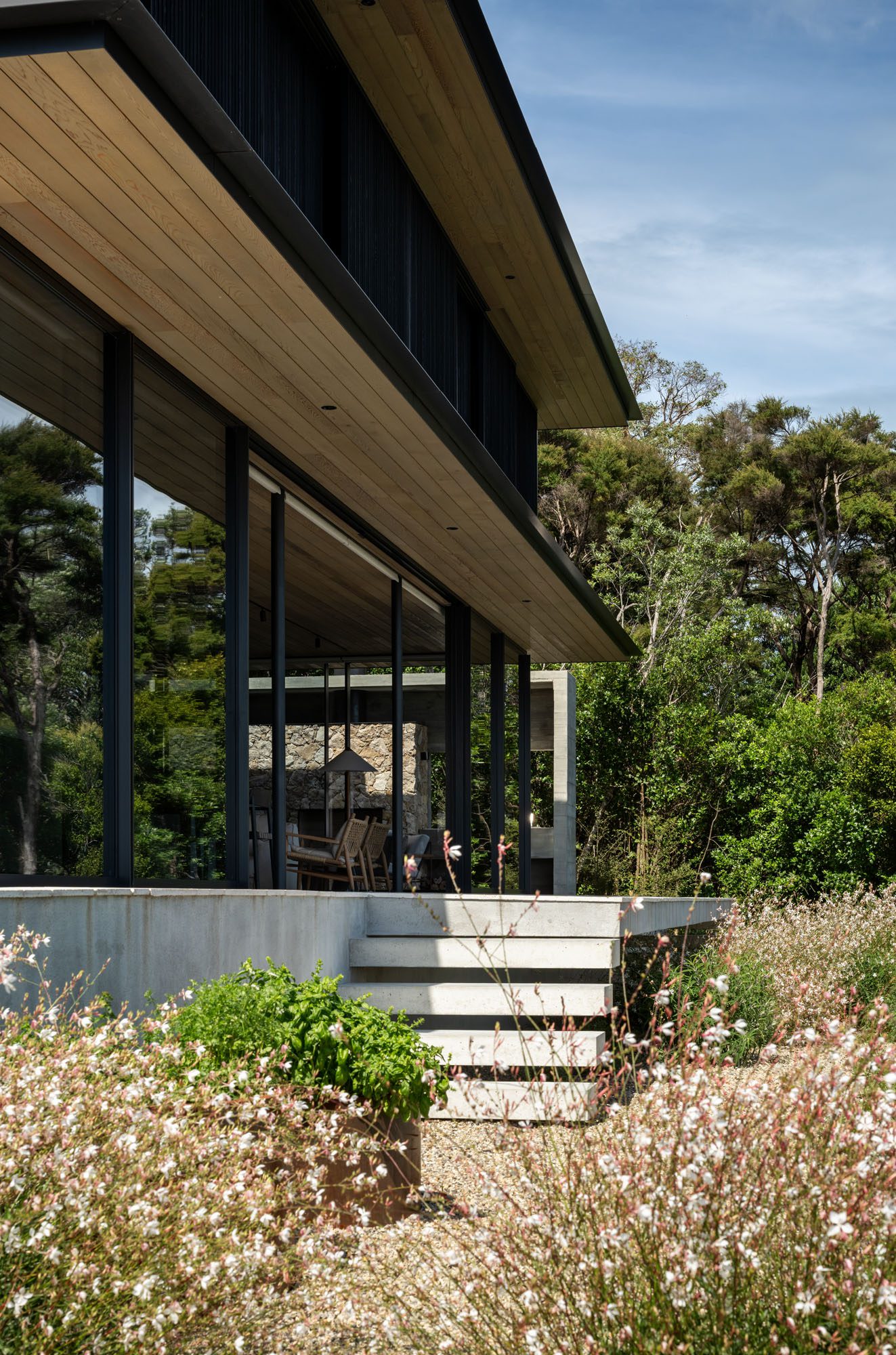
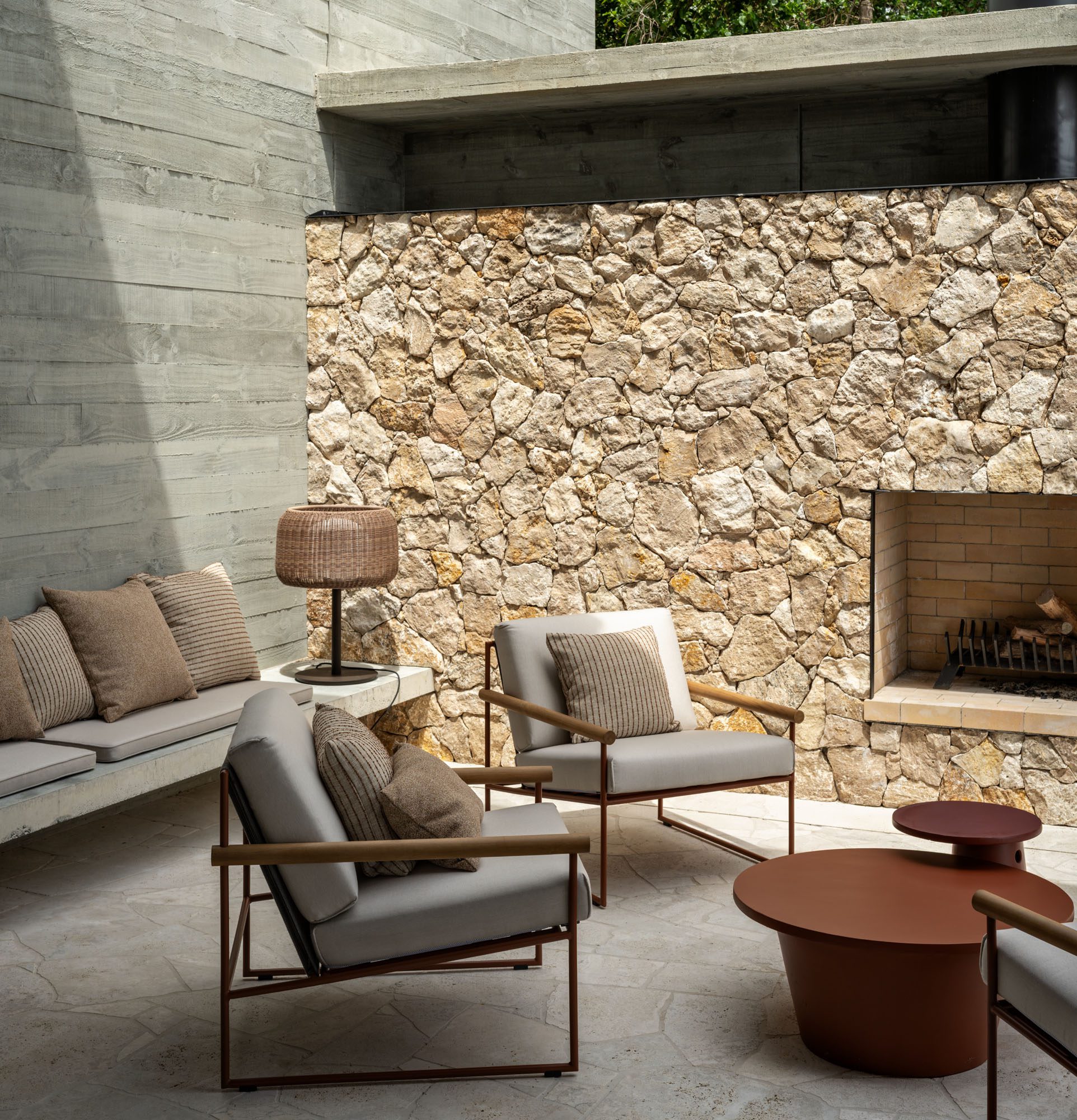
Throughout, the material palette is restrained and tactile. In situ concrete, dark-oiled timber, stone and lime-washed wood appear throughout — materials that age honestly and carry the memory of making. Board-marked concrete reads against the close grain of timber, while lime-wash softens the palette with muted chromatic warmth. The juxtaposition of heavy (concrete, stone) and light (glass, timber) becomes a recurring tectonic theme: a sort of animated dialogue between mass and membrane.
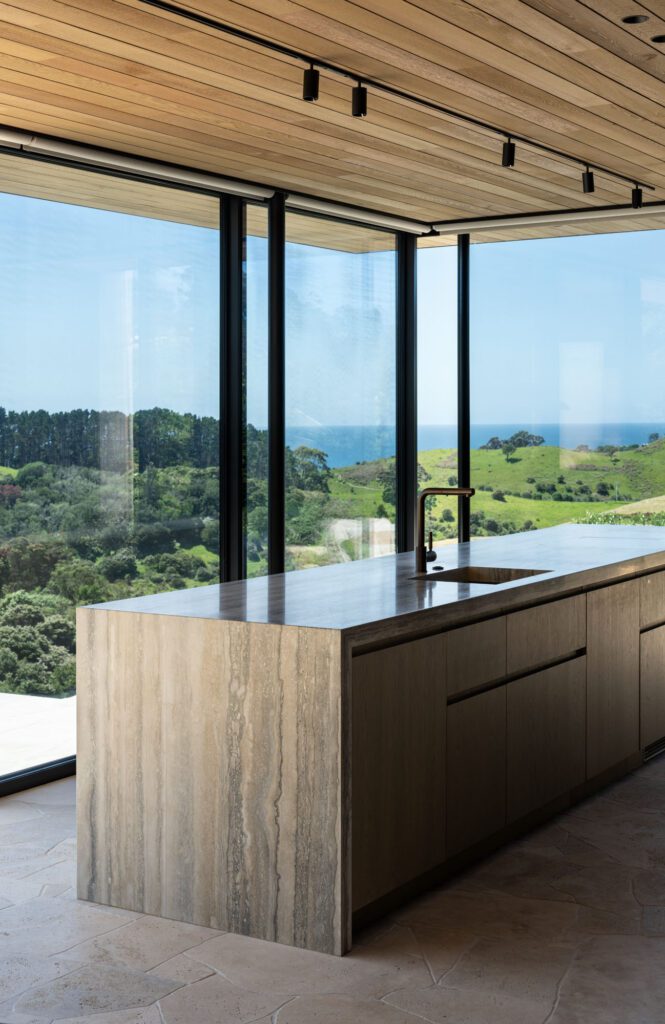
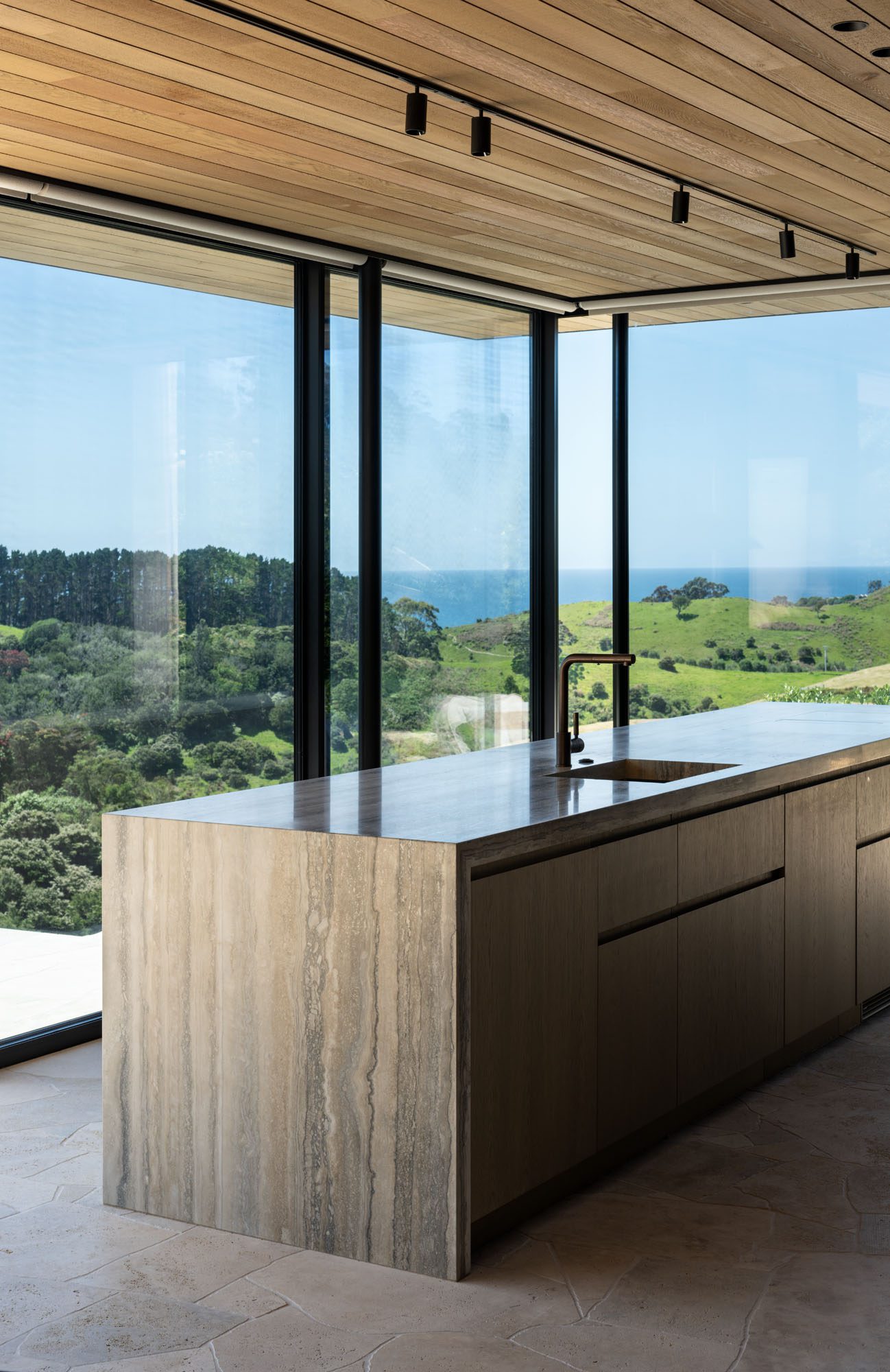
Freeform-cut Scala Travertine tiles from Eco Outdoor set a pale background for furniture ranging from an older timber dining table to pieces from ECC, Cult, and Studio Italia. A sculptural concrete bench, timber-lined ceiling, and carefully proportioned wood fire (F.L. Bone’s Cheminées Philippe Radiante 692) contribute to the room’s composed atmosphere.
“I’m under the idea that in winter, if it’s really cold, you could snuggle up by the pot belly fire up there,” Julian muses.
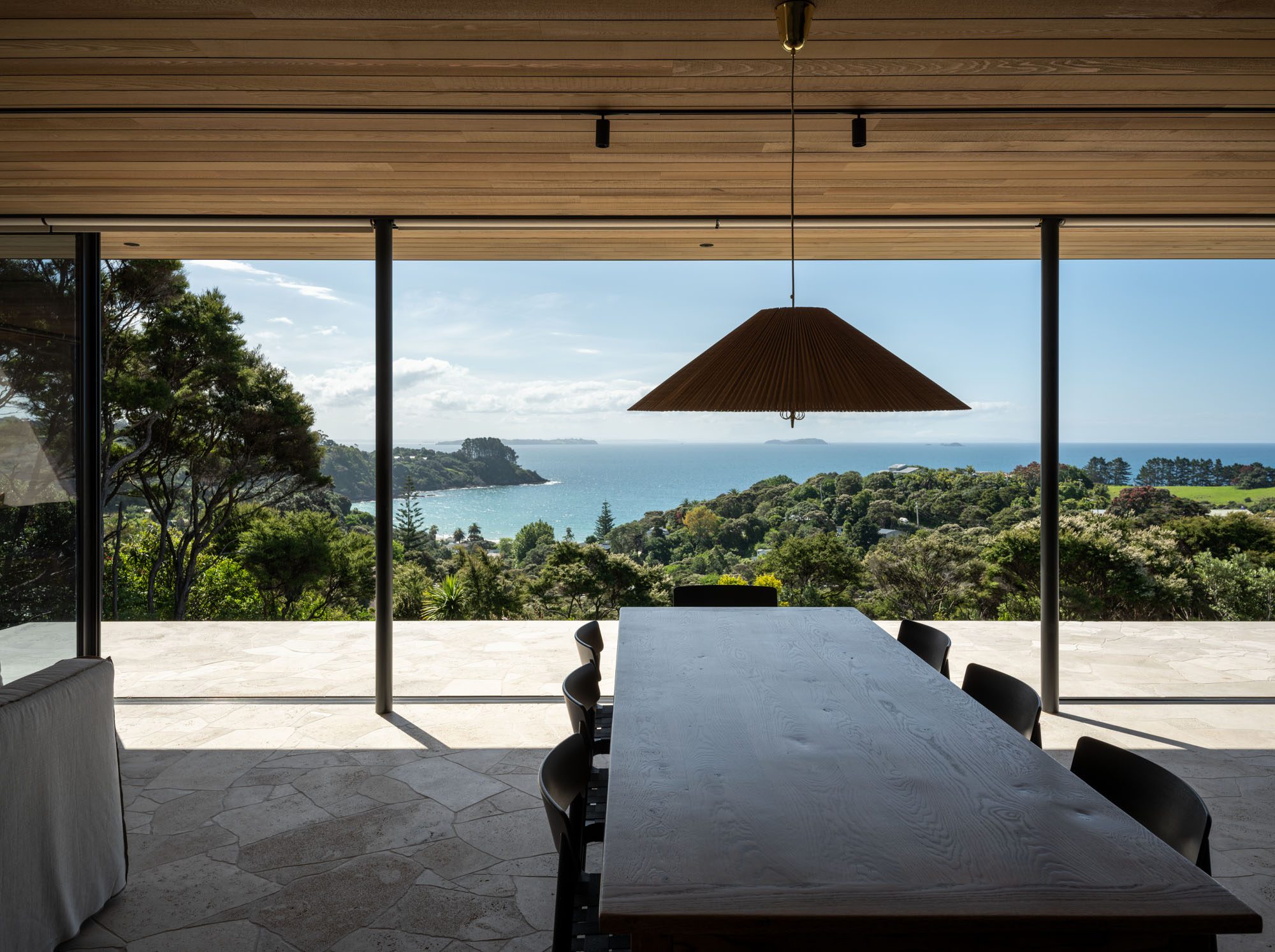
The living space opens visually to two adjacent outdoor areas, giving the house a subtle Brazilian modernist inflection: a blend of sculptural mid-century sensibility, rich natural materials, and seamless connection to the views. Details such as rattan kitchen cabinetry and the expressive Gubi 1972 pendant (bamboo slats hand-sewn into a pleated mat) complete a scene worthy of the sun-drenched hills above Ipanema.
“We don’t really want to leave!” was the unanimous verdict of the judges while on tour.
Ultimately, Julian achieves an interior of calibrated intensity: calm, tactile comfort, and immersion in nature emerging not from decoration but from the resolution of section, structure, material, and light. The house does not impose itself on the landscape; it holds still within it, watching the sea.
Judges’ Citation
This project proposes a compelling residential typology: compact, efficient, and perfectly at ease within its suburban streetscape. Symmetrical, calm, and rigorously resolved, the design stood out immediately to the judges.
Within a remarkably small footprint, careful planning has created a surprising sense of generosity, with clearly defined spaces and a floor-plan that functions beautifully. The restrained material palette reflects the disciplined brief, directing investment towards performance rather than ornament: high-quality joinery and thermal efficiency taking precedence over embellishment.
Elegant, thoughtful, and refreshingly pragmatic, this modest house demonstrates the way in which good design can deliver affordability, sustainability, and architectural clarity in equal measure.
Project Credits
Architecture: Julian Guthrie Architecture
Build: James Bros Ltd
Words: Federico Monsalve
Images: Simon Devitt
Tapware: Plumbline
Tiles: Designsource, Eco Outdoor
Benchtop: SCE Stone
Lighting: ECC
Fireplace: FL Bone
Indoor Furniture: ECC, Studio Italia, John Stephens, Woodwrights
Outdoor Furniture: Wolf and South, Cult